Showing posts with label Nee's Recipes : Asian Rice/Noodles/Dim Sum. Show all posts

Sunday, March 28, 2010

Repost: Pan Mien

I am doing a repost of this because there is a loving guy out there who wants to do this for his girlfriend. Sweet! Greg doing this for me hmmmm...i cant imagine the mess after. Anyway, "interested", hopefully you get the hang of this before she comes home.


We have this in KL all the time, so I've always thought it as of West Malaysian origins. Then again I had a nice one in KK Sabah and Sabah got Sayur Manis. Maybe it is Sabahan. Anyone?

When I serve this for cell, many of them dont know what exactly is Pan Mien. So it is definitely not a Kuching thingy. There used to be a hawker store at Thompson's Corner (Tabuan Jaya) selling this. Apparently, business was so good that they were always sold out before noon. Now it is completely gone. The guy must have made enough and decide to take out early retirement (my guess).

Greg loves Pan Mien and with no where nice to go, I have to take up the task of figuring how to make some myself in case he starts having withdrawal syndrome. Me too for that matter. A while ago, there was a demonstration class showing how to make the actual Pan Mien noodles. Thank God!

The Soupbase:
3 litre of water
300gm of pork bones, washed and parboiled to rid blood and smell
3-4 no of chicken bones, washed and parboiled with pork bones
20 gm of ikan bilis
300 gm of lean pork (leg meat), seasoning with salt, sugar, pepper, cornstarch and water
1 bunch of mani chai or sayur manis
120gm of pork balls
20 gm of black fungus (soaked in water) or some fresh ones is nice even better
1 tbsp of minced garlic
1 tbsp of oil

The noodles:
200gm of flour (plain or key flour)
1 no of egg
some salt
approx 100 gm of water

The Accompaniment:
20 gm of ikan bilis, cleaned, dried and fried with some oil til light brown and crispy
Chilli padi, mixed with some maggi seasoning and some light soya.
300gm of minced pork, seasoned with light soya, salt, pepper and sugar, cornstarch and water, stir fry with 1 tbsp of garlic and oil til cooked. Scope onto noodle and soup before serving.

1) Boil water. When boiling, add bones and ikan bilis and simmered for 1hour or more. Strain for the soup only. If you are running out of time, 1 to 1 1/2 cube of pork or chicken stock will have to do.

2) Heat oil in wok, add garlic and stir fry lean pork. Add pork balls, black fungus and stir fry til fragrant.

3) Add to soup. Continue simmering for another hour or so. Before serving, add mani chai and boil for a few minutes before adding noodles.

4) For noodles: Mix all ingredients in a bowl and stir until well combined. Knead into a small dough. If too wet, add some flour. The dough should be not be firm but soft when you hold it. Rest for 10 min or so.

5) Cut into four. Sprinkly some flour on working surface and rolling pin, roll into rectangles. If you use a noodle maker, run it through the flat sheet mode and roll from biggest to the third biggest (say if No 1 is your noodle maker biggest gap, 3 will be third). Run through 2 times at each no and sprinkle some flour on dough sheets surface each time. Cut with the fettucine mode. Separate the noodles as they tend to stick together.

Note: A good pan mien dough is soft and it will not shrink during rolling. If you dont have a noodle maker, just roll the dough as flat as you can and cut into 1/2 cm strips or tear your dough with finger and thumb for flat pieces.

6) Fresh Pan Mien noodles goes straight from dough strips into soup mixture. Boil the whole combination until noodles are cooked. The dish is very slightly on the floury side. Add salt and pepper to taste.

7) Serve with Fried Ikan Bilis, Chili padi sauce and Fried mince meat.


Once you get the hang of it, preparation can be quite easy and fast. Yet the dish is so clear and nice and of course not as fattening. The key is fresh noodles!

Friday, February 27, 2009

Kuching Kolo Mee

This is another very long overdue post, which I prepared a while ago, but completely forgotten about it until I checked the drafts. And CI, this is the other recipe that I did not manage to give you before you leave for the States. And I have simplified it into a simpler and healthier version.

KoLo Mee (Mee Kolok, Kon Lou Mien) is a very popular Kuching hawker fare. It is basically noodle (curly type in Kuching), stir with garlic and/or shallot oil, not unlike the Italian Aglio Olio. In Cantonese, it is called Kon Lou Mien and the Foochows also have a version called Kam Pua Mien. All of them mean the same thing - dry noodles.

The toppings are individually added, ranging from the humble spring-onion-only, which is essentially called Mee Kosong meaning Empty Noodle (Dad always says his kam pua kosong cost only 10 cents when he was a poor lad); to roast meat topping like char siew or roast chicken; to small & super seafood like jumbo prawns and fish fillets with one type of vegetable like choy sum or curly vegies.

Good kolo mee needs good fresh base oil. Good shallot oil is a must for Kolo Mee. Traditionally lard is used. Take pork fat cubes and place them in wok & heat up with a tablespoon of vegetable oil. Turn to low and slowly let the fat release the oil till the fat shrinks and turn golden brown. You get your crispy pork leftovers (chu yu cha) this way. Crispy pork is really yummy with stir fried vegies and is very popular in Penang Char Kueh Tiaw. Try this if your arteries are still young and vibrant.


Base Shallot oil:
8 shallots
1 cup of vegetable oil

1) Slice the shallots up thinly and chop them up slightly. Wet it with some water. Turn on the fire and heat up oil only very slightly before quickly placing the wetted shallots in. This way shallots will not be burnt before they could release their fragrance. Let the shallots simmer in warm oil till fragrance are released. Turn up heat right before you dish out to cook the shallot golden brown.

Shallots will continue cooking even after taking them off the fire, so dont brown it too much. You can separate oil with shallots for storage or if you are using it soon, they can be kept together in one container. Set aside for later use. Should keep up to one month out of refridgerator.

To make one bowl of Kolo Mee as a main meal:

2 tbsp of shallot oil, with or without shallots
1 tbsp of fish sauce, instead of msg
1 tbsp of light soya sauce
1tbsp of dark vineger (latest trend in Kuching, optional)
1/2 to 1 tbsp of dark soya sauce (optional for colour)
1 tbsp of chilli sauce (optional if you like it slightly spicy)
Sprinkle of pepper
150gm of curly noodles/Kampua noodles (about 4 portions for 500gm of curly noodles)
Water, one pot boiling another one room temperature
pickled chillis

Toppings suggestions:
char siew ~ pork or chicken
soya sauce minced pork
Stew meat and sauce
fish, pork or prawn balls, placed in boiling water
Large prawns, cleaned and sliced halves and pan fry with salt and pepper or just boiled with water.
Fish Fillets like mackerel (scrapped off) or white pompret (sliced), pan fried with salt and pepper
vegies like curly vegies or choy sum, cooked in boiling water

1) Prepare the bowl with shallot oil, fish sauce and light soya.

2) Prepare toppings and side aside.

3) Heat a bowl of boiling water and place noodle in water, stirring all the time with a pair of chopsticks to loosen the noodles till cooked about 1 min or so. Dish out and quickly dunk into the pot of room temperature water. Dip it back into the boiling water for a few seconds. Strain to dry. And toss noodles in the bowl of sauce.

4) Place toppings on and sprinkle slightly with pepper and top with spring onion or crispy shallots. Serve with pickled chillis and a bowl of vegie soup.

My dear hubby will get his bowl for Saturday or Sunday lunches. And he gets jumbo prawns, fresh mackerel meat straight from the bones to the pot, veg and fish balls. He gets his homemade char siew version too. But he has the cheek to complain that my char siew is not RED. I am very sorely tempted to take up Jo's suggestion to paint the meat red with his poster colour. But that means that there is nothing that he can complain about the noodles. But do adjust the seasoning according to your taste. Whether your bowl will taste authentic really depends on the base oil.

Monday, November 3, 2008

Foochow Cha Chu Mien (Fried Cooked Noodle)


I had prepared this post for a while but wanted to get the ingredients more accurate. And Maria, one of our readers requested for this. So hopefully it will worked for you!

This is a very distinct foochow dish in Malaysia like the Hokkien Noodle of the Hokkiens, Hailam Mee of the Hainans, Cantonese Hor fun for the Cantonese, Heng Hua Mee of the Heng Huas etc. Definition of Cha Chu is to stir fry the noodle first, then to cook it in superior soup. Cha basically means stir fried and Chu means cook. So this dish is basically a soupy fried noodle dish popular among the Foochows in Sarawak. The name itself gives a good indication of how to cook it. And when we do it at home, we can really use good ingredients like good fish fillets or huge prawns. And cooking at home does not mean the taste is inferior, in fact it is really delicious.

Serve 3-4
450gm of Oil Noodle, get the freshest and best quality ones (those with eggs instead of colouring) you can find
3 tbsp of oil
1 tbsp of minced garlic
3 tbsp of good quality dark soya (Chinese ones like Pearl bridge are NOT recommended, try Camel or Yeo Hiap Seng or Lee Kum Kee)
1 tbsp of light soya
3-4 tbsp of Foochow Red Wine

1) Loosen and clean noodles by running through some hot water. Heat up wok with oil. Add garlic and stir fry till fragrant. Add noodles and with two spatulas, toss noodles. Add dark soya and light soya. Continue tossing. Add red wine. Toss till all ingredients are even. Don't overcook at this stage or you will get mushy noodles later. Process should take less than 5 min. Dish out and set aside.


1.2 litre of superior stock (Simmer pork bones and chicken bones with slightly over 2 litre of water for more than an hour or if you ran out time 1.2 litre of water with 1 tbsp of chicken stock powder like Knorr)
200 gm of fish fillet like Tapah, Patin, Garoupa
4 pcs of fresh water King Prawns halved or 8 pcs of XL sea prawns
80 gm of chicken/pork meat, sliced
4 stalks of medium choy sum
2-3 pcs of dried black fungus, stripped
100 gm of pork balls, fish balls, fish slices, liver (optional)
approx 3/4 -1 cup of Foochow Red Wine (quantity based on taste)
3 tbsp of dark soya
1 teasp of pepper, salt and msg to taste

1) With a little oil, stir fry meat slices to cook the exterior. Add stock and bring it to boil. Add black fungus, balls and let it simmer for a little.

2) Add the large prawns followed slightly later by fish fillets while the stock is kept simmering.

3) Return noodles to stock. Add choy sum and dark soya, seasoning and half of foochow red wine. Turn to boil till all ingredients are cooked. Dish out noodles onto individual bowls, divide the rest of ingredients evenly followed by the soup to cover noodles. Drizzle rest of red wine evenly right before serving.

Tuesday, October 28, 2008

Yam Rice

I saw this dish in the latest issue of the Food and Travel Magazine and it looks yum and pretty simple to cook. Also I was very inspired by the Teochew Peach Rice Dumpling's (Bee Pao Bee)way of making the rice filling. So I incorporated the same method here.

2 cup of jasmine rice
1 tbsp of garlic oil
1 teasp of salt and pepper

1) Cook the above in a normal rice cooker with enough water. Keep warm.

200 gm of good quality yam (weight after shaving), diced into cubes
35 gm of dried prawns, washed and chopped into smaller bits
30 gm of dried scallops, soaked and loosened
3-4 pieces of dried chinese mushrooms, soaked and diced into small cubes ( i forgot here)
1 piece of good quality chinese sausage (optional), cut to small cube (also forgotten)
1 1/2 cup of chicken stock
1 tbsp of sesame oil + 4 tbsp of cooking oil
2 tbsp of shallots, chopped finely
1 tbsp of garlic , chopped finely
1 tbsp of light soya
pepper
salt to taste (be careful as dried prawns & scallops can already be quite salty)


1) Heat up oil and pan fry dried prawns till fragrant. Add shallots and garlic and continue stir frying till garlic and shallots are soft and fragrant.

2) Add mushrooms, chinese sausages followed by scallops and yam. Stir till well mixed and fragrant. Add seasoning, soya and chicken stock and let the mixture simmer till yam is soft and stock is drying up.

3) Dish out into the rice pot and stir to evenly mix yam mixture with the rice.

4) Serve in bowls topped with garnishing (spring onion & fried shallots).


Monday, August 18, 2008

Fish Mee Fen

Greg and I have always been quite telephatic about food. When we were dating, he would sometimes suggest to go for a certain food at a certain place and that would be exactly what I had in mind.

Recently it happened again. I was wondering hard what to cook for dinner because I knew I would have a busy evening ahead. So I decided on this dish "Fish Mee Fen (Bee hoon)". Before I reached home, Greg called and he said he had a craving for Fish Mee Fen. How is that for telephatic?

Greg: This is fun. Nee is like a cooking machine. You just press the button, & the food will come out
NEE: No, he just need to send a signal and my antenna will receive it.


This is a very simple yummy dish to cook. Greg can down a whole bowl all by himself. The recipe is actually for fish head. But both of us don't know how to take this so called excellent part of a fish but Greg seems to be slowly adapting to it as compared to me. I figured it is an acquired taste. So I normally use fish meat to cook this. Or I would buy a whole fish and chop it into cutlets and half the head. Fishes like Tilapia, Red Snappers, Garoupa or the more expensive Ngo Hoo cutlets are all good. I even try a fish called Banana fish because of yellow fins, available at Choice. I was going to try Hai Lian and I actually bought one for RM17, then Mum warned me that this type of fish sometimes has parasite worms sticking to its backbone. Errrrgggghhh....that was a big put off. I just can't bring myself to cook that one. So guess where it went?


Serve 3-4

600-800 gm of fish, cleaned and cut into cutlets, seasoned with
2 tbsp of light soya
2 tbsp of huatiaw cooking wine
1 tbsp of salt
1 cup of cornflour
4 cups of oil for frying

For the soup:
1.5 litre of water + some chicken bones (or 1.5 tbsp chicken granules/2 cube of stock)
3 no of big tomatos, cut into wedges
4-5 slices of ginger
1 tbsp of garlic
2-3 leaves/pcs of salty mustard or xien cai, washed slightly and roughly chopped
1 big red chillis, de-seeded, cut into thick strips
1 pc of tofu (optional)
1/2 cup of huatiaw cooking wine
2 tbsp of light soya
1 tbsp of ideal milk (optional)
1tbsp of cooking oil + 1 tbsp of sesame oil
Salt and pepper to taste
1/2 packet of thick mee fen

1) Soak Mee fen in room temperature to soften. Boil with hot water to cook mee fen. Strain and set aside .

2) Cook the superior chicken stock or use instant chicken stock. Keep stock simmering.

3) In the wok, heat up oil. Add ginger and garlic and stir fry till fragrant. Add xien cai, chilli and tomatos. Stir fry for a min or so. Add seasoning leftover from fish. Add light soya and huatiaw.

4) Transfer the mixture to the pot of simmering stock. Turn up fire and boil. Once boil, let stock simmer while you deep fry the fish cutlets. In a clean wok, heat up 4 cups of cooking oil. When oil is hot, add fish pieces. Fry till golden brown. Dish out and drip off the excessive oil.
5) Taste the soup and add seasoning like salt and pepper. Add ideal milk for extra richness and colour to the soup.

6) Divide mee fen into 4 bowls. Place 2-3 pcs of fried fish pieces and tofu pieces into each bowl and ladle the soup generously for each bowl. Divide tomatos and xiencai to each bowl. Sprinkle with some chopped spring onions or coriander as garnishing. Serve with soya and cut pickled chillis.

Note: If you don't want to fry your fish, you can pan fry like what Terri did with hers.

Wednesday, August 13, 2008

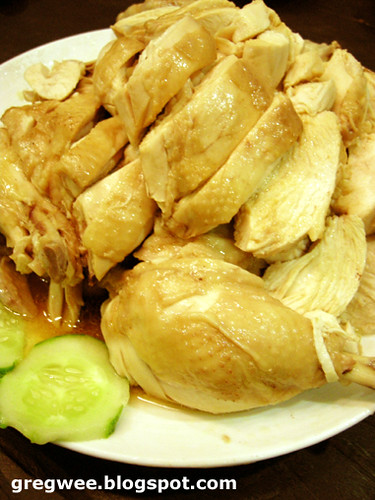
Hainan Chicken Rice


A while ago, our good friend and an accomplished violinist, who played at our wedding, Sie Ai, left for the States for her PhD. Before she left, I was supposed to write her a list of recipes for local food (as payment for her services - just kidding). And one of it is this dish which I have been procastinating.

And guess what? Two nights ago, she actually popped up at our place. It was a surprise visit and we were totally shocked. Greg's teeth nearly dropped out. She was back to collect some data and decided to surprise us. Thank you Sie Ai for thinking of us. But it kind of reminded me that I had not blogged any of the dishes which she requested before. How terrible of me!

So since I had cooked this a week ago, I thought I must write it down before I get lazy again.

Hainan Chicken Rice is basically a set meal of rice with chicken, served with chicken soup and chilli and ginger dip. From rice to all the accompaniments, the chicken soup stock from cooking the chicken is used. And it is really not difficult to make. My problem is always cutting the chicken up nicely and evenly and of course picking the right chicken to use is important too.

Serve 4-6

The Chicken
1.8 to 2 kg of chicken*
1 tbsp of salt
1 tbsp of minced garlic
1/2 tbsp of minced ginger
3-4 stalks of spring onion
1 no of thumb size ginger smashed
Water to cover chicken

1) Mix salt, minced garlic & ginger together and rub it all over the chicken. Stuff the spring onion and smashed ginger into the cavity of the chicken.

2) Boil a large pot of water and place the chicken in tummy side down, water covering the chicken. Boil over med-hi fire for 10-15 min depending on the size of the chicken. Turn the chicken over and continue boiling for another 9-12 min. Check for doneness by piercing the thigh area and check for the juice that runs out. If it is still pink, continue boiling for another 5 min or so. Turn off fire and let the chicken soak in the soup with lid of pot closed for 30 min. Soaking will help the chicken texture to be smoother.

* Choosing the right chicken is essential. I personally like corn fed or free range ones with nice layer of skin for chicken rice purpose And I would normally ask whether the chicken feather is hand plucked or machine plucked. Machine plucked one usually thins out the skin, causing it to tear during boil cooking. But it is a matter of preference. Some people actually like whitish looking, naked fatless chicken with practically no skin on.

3) Carefully dish out the chicken and place on a plate to dry. You can hang it if you want to. Spoon some chicken oil sauce over the chicken, gentlly rub the sauce all over chicken and let it cool before cutting.

Chicken Oil Sauce:
1 rice bowl of top layer of chicken soup and oil, especially the oil bit
1 tbsp of sesame oil
3 tbsp of light soya
1/2 teasp of sugar

1) Mix all ingredients together.

The Rice:
450 - 500 gm of jasmine rice
50 gm of glutinous rice
2-3 stalks of pandan leave
2-3 slices of ginger
1 tbsp of minced garlic
1 teasp of salt and pepper
500-600 gm of chicken soup and oil, more if you like your rice wetter

1) Wash the rice and strain off water.

2) Heat wok with oil. Stir fry garlic and ginger till fragrant. Add rice and continue stir frying. Add salt and pepper.

3) Place in normal rice cooker. Add pandan leaves and chicken soup and cook like usual.


The Soup:
1.5 litres of Chicken soup
1 no of Szechuan vegie, size of baby fist, washed and sliced thinly
1 stalk of salty vegies, washed

1)Boil chicken soup and add the vegies. Simmer for a little while before serving


The Sauces:

a) Chilli Dip

5 no large chillis
10 no of limau
2 tbsp of sugar
3/4 tbsp of minced garlic
some salt approx 3/4 to 1 teasp
5-6 tbsp of chicken oil from the soup

1) Chop or blend chillis and 3-4 limau skin into fine bits.

2) Squeeze limau juice. Mix all the ingredients together. Set aside.


b) Ginger and Onion dip

50 gm of ginger
50 gm of spring onion bottom white part
1 tbsp of sesame oil
3-4 tbsp of chicken oil from the soup
1/2 teasp of salt

Edited: I realised that I did put instruction for my dip. Shred the ginger to fine bits. Chop the spring onion bottom to fine bits. Add oil and chicken oil and seasoning.


c) Dark soya Sauce

Serving:
Dish rice and press tightly into a rice bowl and flip it onto a serving plate. Cut chicken and place them on individual plates or a large centre plate. Spoon more chicken oil sauce over meat right before serving. Garnish with cucumber and top with coriander leaves. Serve with soup and dips and soya sauce.

According to Greg's Uncle Francis, chicken rice in Hainan does not taste like ours and is certainly not so flavourful. So let's enjoy our version. It is not sooooo difficult to make. So if you are worried about commercial chicken rice outside, DIY.

Friday, July 4, 2008

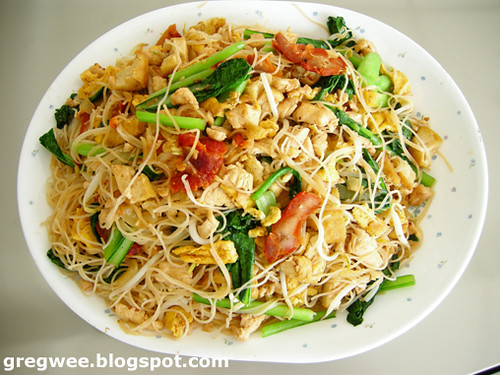
Fried Bee Hoon


Greg and I always enjoyed Bee Hoon or Mee Fen (Mandarin), also known as Rice Stick among the fried carbs. Normally we like our Fried Beehoon clear and whitish, that is frying without dark soya. However, the usual ones available commercially are darkish in colour unless we are very specific about it. The ones in the pictures are done with a tad too much of light soya and the char siew, being commercial, actually coloured my mee fen. Hai...that is always the problem with outside food unless you know and frequent certain shops and are sure that they don't cost cutting in fancy ways.

I normally use Jiang Men Mee Fen from China. According to the grocer, this brand is good even for beginner cooks as it does not break up easily or gets gluey after frying. I find it quite true. Finding the right mee fen is important as some do not withstand the process of soaking, the rigorous tossing and stirring. A good plate of mee fen should be soft yet the bite is still there. It is really not attractive to eat a plate of breakup mee fen. Mee fen at home will never really have the wok breath of the commercial ones nor the oiliness, so dont expect that. But we can still make it tasty and wholesome.


Serve 4


1/2 packet of Jiang Men Mee Fen
200gm of chicken dices
80 gm of char siew or luncheon meat or prawns
2 no of eggs
1 piece of tofu gan, cut to 3-4 pieces
30 gm of bean sprout
50 gm of chives or 2-3 stalks of green vegies like chai sim, sliced
Other optional items ~ pork rolls, mushrooms
1/2 no of onion, chopped
1 tbsp of garlic, minced
6-8 tbsp of cooking oil

Seasoning Liquid:

Mix 200 ml of water with 1 tbsp of chicken powder + 1 tbsp of light soya + 1 tbsp of salt + some pepper + 1/2 tbsp of sesame oil and stir them well. Or use fresh 200ml of chicken superior stock + rest of seasoning. Dont ever throw in the seasoning separately because you tend to toss mee fen too long this way and if not evenly tossed, you may get some part salty, some part bland.


1) Soak Mee Fen till soft. Drain and set aside.

2) Season chicken dices with 1 tbsp of light soya, 1/2 tbsp of sugar, 1/2 teasp of salt and 1/2 teasp of sesame oil, 1 teasp of cornstarch and 1 tbsp of water. I normally like to season my meat a little as it gives not only a better fragrance but also smoother texture. Set aside.

3) Beat up eggs and pan fry to thin pancake like shapes. Slice up and set aside. Pan fry tofu gan pieces on all sides, cut them up and set aside.


4) With half of the oil, 1/2 of garlic and over high heat or the strongest fire you can manage on your stove, stir fry the mee fen with two metal cooking spatula or one spatula and one big cooking fork. This is to be done quickly. Dish out.


5) With rest of the oil, stir fry onion and the half of garlic till fragrant. Add chicken, and stir fry till white. Then char siew/luncheon meat/prawns are added. Stir to mix.

6) Vegies and bean sprouts, eggs slices, tofu gan slices are added in followed straight by mee fen in (4). As I can't do the tossing wok act even with two hands, the best option is to use two metal spatula to toss the mee fen for a min or two. This is a better way of cooking as compared to stirring, which tends to break up the mee fen. Add chicken stock seasoning. Continue tossing for another 2-3 min. Dish out and serve.

Wednesday, July 2, 2008

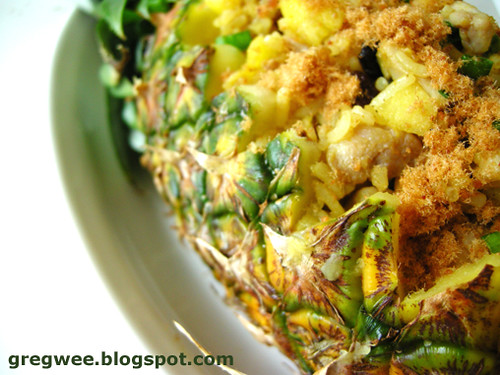
Pineapple Fried Rice

When it comes to food, cooking and baking, I am a very unfaithful person. I consistently have new loves. The latest craze is Thai Food and Sweet Dessert Soup (Tong Shui) related items. But don't worry, I am still in the Italian food phase. With food, I can go crazy over certain cuisines for a period of time (usually not too long :P). Greg can attest that with every new infatuation, I would really research, buy cookbooks, spend hours/days/months on the internet, with endless phone calls to all my sifus/mentors and trying out the dishes many times.


If we talked about Thai Food in Kuching, people will straight away think of Lok Thian Thai Section. Lok Thian will then conjure up Pineapple Fried Rice. I personally think Tom Yum is Thailand's signature export. We have not been to Lok Thian for donkey years. The last time I ate there, this dish was still good. But I'm always worried and wonder whether they change their pineapple casings for every table. Hiak..am I scaring you?


Anyway, if I remember correctly, I saw Terri doing this dish a while ago with a pineapple casing too, and very impressively done I would say. I realised that my rice recipe is different, more of the Lok Thian's style, which we are more accustomed to.


Serve 2-3

Pineapple Casing:
1 kg of ripe pineapple with the crown and stem beautifully attached, or if you are serving for a party find a nice big one.

1) Find an angle that is more presentable and slice the skin a little off the bottom so that the pineapple can sit firmly on a plate.

2) Then slice off the top, starting at 2-3 cm above the stem. And slowly dig out the pineapple flesh with a paring knife. Leave about 1/2 inch thinkness on the sides and bottom. Set aside.


The Rice:
350 -450gm of cold cooked rice, preferrably overnight.
200 gm of chicken thigh, cubed
100 gm of prawn, deveined, deshelled and cubed
1 1/2 cup of pineapple, cubed
3 no of shallots, chopped
3 tbsp of vegie oil
1-2 tbsp of light soy sauce
2 tbsp of fish sauce
2-3 heaped tbsp of curry powder like Babas
3-4 tbsp of sultanas
4-5 tbsp of meat floss
Chopped spring onion
Seasoning ~ salt, pepper and msg to taste

1) Season chicken dices with 1 tbsp of fish sauce, 1/2 teasp of salt and 1 teasp of sugar, 1 teasp of cornflour and 1 tbsp of water. Set aside.

2) Cut the dug out pineapple into approximately 1 cm cubes. Wet rice to loosen the grains.

3) Heat up oil in a wok. Stir fry chopped shallots till fragrant. Add chicken meat. Cook till white. Add prawns. Cook a little. Add rice. Continue stir frying till ingredients are well mixed.

4) Add fish sauce and light soya. Then add the pineapple cubes, followed by curry powder. Stir fry till fragrant. Add seasoning to taste.

5) Lastly add sultanas. Stir a little to mix well. Dish out into the pineapple casing and garnish with chopped spring onions and meat floss.

Thursday, June 19, 2008

Fish Ball Tang Hoon


Fish Ball Vermicelli is an excellent 'clearing' dish. It is something that Greg and I would eat should we want a light meal at home. And there is nothing tastier than homemade fish balls. It may not be as super smooth as commercial ones but the taste is really pure fish sweetness. So I strongly recommend making your own for this recipe.

Homemade fish balls can also play a part in Fish Mee Hoon and Hakka Yong Tou Fu dishes or just throw some of them into clear vegetable soups for additional bites.

Serve 4-5
The Fish Balls
350 to 400gm of mackarel fish meat
2 teasp of salt
1 teasp of pepper
3 1/2 tbsp of cold water
3 tbsp of egg white
1 1/2 teasp of MSG

1) Choose a nice fresh medium sized, flat mackarel fish. Do a three part filleting on the fish. Scrap the fish meat with a spoon.

2) Place fish meat in chopper/mincer machine and mincing for a minute or so. Stop to add seasoning and continue mincing. Add egg white and water and mince till fish glutten can be seen at the side of the mincing bowl.
3)Dish out the minced fish paste. Prepare a bowl of icy water with ice in it. Wet your hands a little or if you have warm hands like mine, dip your hands in the cold water and with the same hand, start beating the fish meat against a flat surface. Scoop up and continue beating till the paste looks smooth and feels springy. Wet or dip your hands as you go along.

4) Once ready, hold some paste in your hand and do the fist motion. Paste will be squeezed out from your thumb and forefinger. With a wet metal spoon, scoop the paste right into the cold bowl of water. Continue till paste finishes.

5) Soak balls for 20 min or so in the icy water. Prepare a pot of water and boil fish balls till they float to the surface. Dish out and set aside. You can freeze balls for future usage.

The Tang Hoon Soup

3-4 bundles of vermicelli (tang hoon), soaked till soften
1/2 tbsp of minced garlic
1/2 tbsp of minced shallots
3 tbsp of cooking 4
1.5 - 1.8 litre of superior chicken soup
2 tbsp of light soya
vegies like Q chai, blanched in hot water
Perserved Dong chai, chopped (optional)
salt and pepper to taste

1) Heat pot with oil, stir fry garlic and shallots till fragrant. Add superior chicken soup and light soya. Simmer for 10 min or so. Add fish balls and bring it to a boil. Add salt and pepper to taste.

2) Cook tanghoon in boiling water and rinse with cold water. Divide into 4-5 bowls. Divide vegies and place a little bit of dong chai into bowls, and dish out fish ball soup and fish balls to each bowl. Serve with cut chillis and soya.

Thursday, June 12, 2008

Claypot Chicken Rice with Salted Fish


"Ham yu gai lap poo chai fun" is basically one dish, which is a member of the claypot rice family along side with Lap Mei Fun (Perserved meat rice). It is very interesting to note that cooking rice in a claypot over stove fire is so fast, something like less than 10 min. And claypot gives the whole dish a very nice flavour, somewhat more fragrant, I suppose.

And by the way, you can buy very nice cheap chinese claypots at the Super Discount Store near 3rd Mile Flyover. I bought three ~ big, medium & small for RM 5, 4, 3 respectively. As Greg would say in Hokkien "Pee kao lau sai" ~ Cheap until diarrhae. No point buying those RM20 over or RM50 claypot. These Chinese ones are super durable and of course if you break them, you don't have to cry. And they look pretty presentable too.

Serve 3-4
350 gm of fragrant rice
1/2 tbsp of garlic
1 teasp of salt
1 teasp of pepper
1 tbsp of dark soya sauce
3 tbsp of cooking oil
450 gm of water

1) Heat up wok with oil. Add garlic and stir fry till fragrant. Add rice and stir fry till rice feels a little sticky and heavy. Add soya, salt and pepper.

2) Dish out into a claypot and add water. With med-high fire, cook the rice with lid closed for about 8-10 min till rice is almost cooked and water is almost all gone. Rice will look very wet at this stage.
You can start to cook the rest of the ingredients before the rice so that the chicken can be well simmered.

450 - 500 gm of chicken meat, you can use thigh fillet and diced it up (hence, the gai lap), but i normally go the whole piece with bone attached. Just chop up into 7-8 pieces
1 tbsp of garlic
3-4 pieces of sliced ginger, shape of the thumb
1 tbsp of sesame oil + 1-2 tbsp of normal cooking oil
4-5 pieces of shitake mushrooms, soaked to soften and cut into halves
1 no of good quality chinese sausage (optional)*, sliced thinly
1 small piece of salted fish, size 2 cm square X 4 cm long, deep fried, cooled and chopped to fine pieces.


Marinade:
2 tbsp of oyster sauce
2 tbsp of dark soya or 1 light + 1 dark
2 tbsp of cooking hua tiaw wine
1 tbsp of sugar
3/4 teasp of salt and pepper each

3) Marinade chicken meat with marinade for more than one hour.

4) Heat up wok with oil and lightly stir fry sausages slices till fragrant. Dish out, set aside and using the same oil, stir fry ginger till fragrant. Add garlic and continue stir frying till garlic turn slightly brown. Add marinaded chicken. Stir fry till fragrant and let it simmer while rice is cooking in the claypot.

5) When rice is ready, spread sausage, fine salted fish pieces and chicken over rice. Close lid and cook at medium fire for another 5-7 minute. 5 min if you like the bottom and side only slightly burnt and crispy. Longer like 7-8 min if you like it more burnt. Edited: The burnt bits are nice and in Hong Kong after the rice is eaten, the restaurant can help you add water to the burnt bits and cook into porridge.

6) Remove from stove and serve.
* optional sausages: please buy good quality ones. Otherwise the taste may be weird. Mine I got from Hong Kong. Really fresh.

Monday, June 9, 2008

Zong Zi Dumplings - Nyonya Style

Zong Zi is basically glutinous rice with fillings wrapped in bamboo or pandan leaves (screwpine leaves) in South East Asia where they are widely available. For many who love this snack, you will know how tasty the nicely cooked glutinous rice dumplings can be, especially with a hint of the aroma of the leaves which they are wrapped in, and of course the fragrance of the nicely balanced fillings, which commonly consist of pork, salted eggs, yam paste, chestnuts, shitake mushroom and many others.

Zong zi, also called Chang in Hokkien and Ch'ng in Foochow, is a common daily sight in wet markets and many coffee shop eateries in Sarawak. Many kuih-muih sellers would sell them as one of their products. Because it is so commonly made, many of us have taken it for granted and have forgotten its real historical and cultural significance. Zong zi does not only have a unique story attached to it but the way it is made, the way it is wrapped and the type of fillings used define the group of people making them.

Zong zi is actually eaten on the 5th day of the 5th month in the Chinese Lunar calendar (Duan Wu Festival) which is usually between June and July of the Western Calendar (8th of June for 2008). The story goes that during the period of the warring states in Chinese history, there lived a famous poet in the State of Chu called Qu Yuan. He was sent to exile due to his patriotic calls, which were against some of the government policies. So in the state of sorrow, he tied himself to a big stone and drowned himself. The people who loved and respected him at that time went searching along the river for his body and could not find it. They then made rice dumplings wrapped with bamboo leaves and threw them in the river to feed the fishes, hoping they would leave his body alone. It has then become a tradition to eat zong zi during this time of the year in remembrance of him. Also dragon boat races are held to mark the occassion.


In Malaysia, with Chinese coming from various dialectic background, Zong zi are actually defined by the dialects. For example, Teochew Zong Zi, Hokkien Zong Zi, Cantonese Zong Zi, Foochow Zong Zi and so forth. Most of the Zong Zi availabe in Sarawak are pyramid shaped ones while Cantonese and Hainanese ones resemble nice fat pillows. The fillings are definitely defined by the dialects making them.


I began making Zong zi last Saturday and the final batches were done on Tuesday as I wanted to make full use of the public holidays. For me, Zong zi is a yearly feat, done to be given away to the elders as a show of respect. So, when making things to give away, I always think it is not so nice to give them away last minute or too near to the actual day.

On top of that, Greg's 90+ year old grandma has officially declared her retirement this year from making Zong zi. So I thought all the more reason for me to be making them!

I ended up making 60 plus pieces of Zong Zi, which were really not quite enough to go around. I did the Hokkien ones (pork with cuttlefish), Teochew ones (pork with yam paste and chestnuts) and Greg's favourite - the nyonya ones (pork with sweet 'kundur' and katumba).


Without sounding too mean and arrogant and no offence, Greg and I don't buy commercially made Zong zi because we are greedy pair who wants lots of meat and fillings in our Zong zi. So we only eat Zong zi once a year when his wife makes them. This year, with two over-60-year-old men, confirming that my Zong zi are just like how their mums used to make them, and with Greg also declaring his newly found affection for Zong zi and would even have them as his main meals, I am completely esctatic about it and thus, dont mind sharing the recipe.


The rice:

850 gm of good quality glutinous rice (find the purest you can grab hold of as it does affect the bites if the rice is mixed with other types, which happen sometimes)
2 teasp of salt
2 teasp of pepper
1heaped tbsp of katumba powder (coriander seeds)
4-6 tbsp of cooking oil

1) Clean and soak rice for about 2-3 hours.

2) Wash and dry coriander seeds. Pan roast till it can fall apart if you press it with your fingers. Blend it to fine powder. Set aside.

3) Heat up wok with oil and stir fry the rice. Add salt and pepper and katumba powder half way and stir fry till you can feel a slight heaviness as you stir. Dish out and set aside.


Clockwise from top: Soaked and drained Glutinous rice, half cook pork dices, diced dry sweetened melon, katumba powder, minced garlic and minced onion


The Filling:

650gm of five flower meat or good grade pork front leg meat, preferrably with some fats
250 gm of dry sweetened melon (kundur/tang tung kua), diced into small cubes
4 heaped tbsp of katumba powder
3 heaped tbsp of chinese red onion, minced finely
1 tbsp of minced garlic
2 tbsp of black soya sauce
4-6 tbsp of cooking oil
Salt, sugar and pepper to taste

1) Blanched pork in boiling water for 2-3 minutes or till half cook and diced into 1 cm or so cubes

2) Heat up wok with oil, stir fry red onion till soft. Add garlic and continue to stir fry till fragrant and lightly brown.

3) Add pork cubes and continue stir frying till meat looks white. Add diced melon, soya sauce, katumba powder, salt and pepper and sugar and cook well. Mixture will look slightly dry not wet. Dish out and set aside to be used.


Bamboo leaves, cut pandan leaves, cooked rice for Teochew Zong zi and nyonya zong zi and filling for Teochew Zong zi (pork with chestnuts, mushrooms)


The Wrap:


Bamboo leaves or pandan leaves*
Hemps or just use strong threads/strings. Dont use colour straw strings.

Bamboo leaves are easily available in supermarkets. Wash and soak them overnight. Wipe them clean before using. Overlap two pieces of leaves with smooth side facing in and shape into a cone.


* Pandan leaves give a very nice aroma & these pandan are of a special type which is long and wide (at least 2/5 inch wide). Greg's Granny actually planted them. If not, it is usually available in wet market at this time of year for now 50 cents or so a piece. Geez.. crazy I think.
Cut off the hard ends, thorns on both sides and divide each leaf into half. Run the upper stem, which is softer, quickly through a wok of hot boiling water. With the lower harder stem, press the stem and run them through the wok of hot boiling water slowly to soften and clean. Wipe and shape into a cone with smoother part on the inner side.

1) Fill up the cone first with one tbsp of rice. Spread rice to side of cone. Add fillings. 2-3 tbsp, followed by another thin layer of rice. Press to tighten.


2) Start wraping into pyramids. And tie them with strings hanging.


3) Prepare a big pot of boiling water enough to cover the over 2-3 cm of all the dumplings. Add 1 tbsp of salt and cook for 1.5 -2 hour, depending on your dumpling size. Add boiling water as you go along. Change dumplings position once or twice half way through. The water must remain covering dumplings all through cooking.

4) Hang the dumplings to dry for about 20-30 minutes before serving.

Happy Duan Wu Jie!

Wednesday, May 28, 2008

Penang Assam Laksa

After our cruise trip and our stops in Penang and Phuket, I was craving badly for Penang Assam Laksa when we got back. That bowl of Assam Laksa at Lebuh Selamat has to be the best I had tasted in my life. So I declared I am officially in love with Penang Assam Laksa.


But sad to say, you can't really find a good bowl of Penang Assam Laksa in Kuching. The closest one would be at Jojo Cafe at 2 1/2 Mile. Greg doesn't like that one cos it's extremely sour & hot.

The one we had in Penang was so well balanced. So I had to take the trouble to do a bit of research & came up with this recipe:

Serve 5-6


The Stock:
1.3-1.5kg of fresh sardine/fresh mackarel (ikan kembung), cleaned and washed well
10 cups of water
5-6 pcs of assam keping
80gm of daun kesum (laksa or Vietnamese mint)*
older parts of 2 bunga kantan (ginger bulb)
2-3 tbsp of assam jawa (tamarind) + 1 cup of water to wash and get the juice


Sardines

Assam Keping

*The ever eluding Daun Kesum (Polyganum Leaves).
I had to order it from the market. Imagine that.


Tamarind (Assam Jawa)

Clockwise from left: Tumeric root (kunyit), Galangal (Lengkuas), Fresh chillis, Dried chillis and Lemongrass (serai) in the middle


The Spices:
8 shallots (chinese red onion)
2 stalks of lemon grass, use only the white part about 5-6 inch, slices thinly into 2 cm long
1 pc of tumeric root (kunyit), slightly bigger than thumb size
1 pc of galangal root (lengkuas), slightly bigger than thumb size
15-18 pcs dried chillis
5 pcs of fresh red chillis
1 pc of belachan, about 2-3 cm cube

1)Boil water in a deep pot and add fish. Boil for 10-15 minute til fish is cooked. Take fish out, cool slightly and de-flaked.

2) Return the fish bone and head to water. Add assam keping, bunga kantan parts and daum kesum and simmer for 1 hour or so. Strain for the stock.

3) Roughly cut all the above spices ingredients and pound with a mortar and pestle or chopper to paste.

4) Fry paste till fragrant. Add the spice paste to soup, followed by assam jawa juice. Simmer for a while and taste for sourness. Return the fish meat to soup mixture. Adjust taste with sugar, salt and fish sauce. Continue simmering on low fire while you prepare to assemble the bowl.

The Bowl:


1 packet of laksa penang (LaiFen)
Thin strips of cucumber, about 6-8 strips per bowl
Thin strips of pineapple, about 6-8 strips per bowl
Fresh mint
Red onion, sliced thinly
some lettuce
chillis, sliced thinly
inner parts of bunga kantan, shredded into the bowl
3 tbsp of prawn paste (hea ko) + 1 tbsp of water (divide one tbsp per bowl)
extra lime (optional)


1) Soak Lai fen till white and soft. Blanch till cooked.

2) Garnish with cucumber, pineapple, mint, onion, lettuce, chillis, bunga kantan and lime.

3) Dish out the hot soup and fish flake over the noodle and add garnishings.

4)Serve with hay ko (prawn paste).

This laksa worked out really well for both of us & we really enjoyed it. It got us sweating all over & our noses were running non-stop. I would not want to compare with the best in Penang but it's definitely good enough to share with people. Hope you'll enjoy it as well!

Nuffnang Ad