Showing posts with label About the Foochows and Dishes. Show all posts

Monday, November 9, 2009

The Dabai Story

The best Dabai (O-lam in hokkien and kra-lan in Foochow) in Sarawak, a kind of local olives, are reputed to come from Sibu. There are usually available towards the end of the year. Prices range from RM12 to even 18/kg. This is one of the few things that my mum would definitely hoard back from every single one of her Sibu trips, without fail.

The preparation for Dabai traditionally includes soaking them in lukewarm water. Normally, these little delicacies will be washed in plain water and placed into a bowl of lukewarm water and soaked with a plate covering for about 20 min to 30 min or so.

But this is where the complexity sets in as the water temperature & the soaking duration has to be just right. The temperature has to be that you can place your hands in it. Any slight miscalculation & the whole thing would become inedible, hard and waxy.

The story goes that once upon a time, because Dabai originated from Sibu, many Kuchingites upon being introduced to them for the very first time, tried cooking them. They fried, stir fried, boiled and obviously ended up puzzled about how Sibu people could actually eat this ridiculously hard thing.

There exists another simpler method of preparing Dabai which we've heard of only very recently. The good thing is that this new method requires none of that temperature control & soaking. All you need to do is to wash and wrap them up in a plastic bag and freeze them. After completely defrosting, they are as soft as they can get. Season them with sweet (optional) dark soya sauce and sugar. And there you go! They transform into highly addictive morsels.

But this is not the end of the story yet, at least for people like Greg. His Dabai journey begins when everyone else finishes. If you're eating Dabai, and you're anywhere near him, you'd need to surrender the seeds to him, otherwise he gets upset.
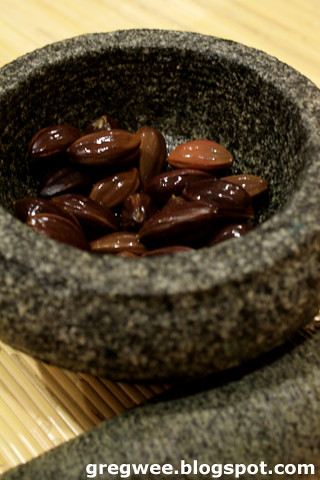
Dabai seeds can actually be eaten. I know that part is true cos Greg has eaten them many times & he's still alive plus I haven't seen any Dabai plant growing out of his butt.
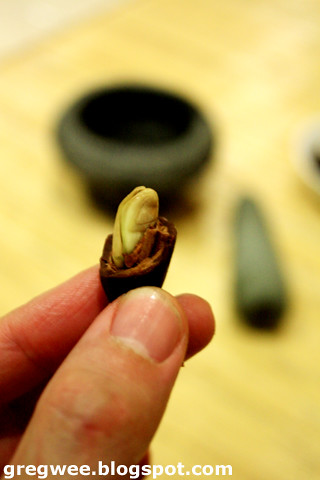
The seed is really hard as Greg would attest. You can see him pounding them away with the pestle & mortar, & debris will be flying off 10 feet away. When the nut breaks away, it reveals a fresh green nutty like filling inside which Greg would meticulously pick out with a toothpick.
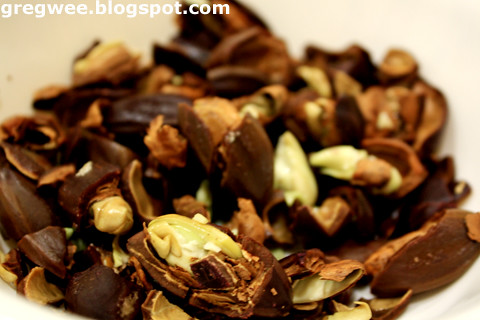
Sometimes I wonder if Greg really likes Dabai, or that he's just trying to gulp down as much as possible just so that he can have the seeds later. But I think whatever it is, as long as he's doing the pounding & the picking himself, he can do whatever he wants.

Monday, November 3, 2008

Foochow Cha Chu Mien (Fried Cooked Noodle)


I had prepared this post for a while but wanted to get the ingredients more accurate. And Maria, one of our readers requested for this. So hopefully it will worked for you!

This is a very distinct foochow dish in Malaysia like the Hokkien Noodle of the Hokkiens, Hailam Mee of the Hainans, Cantonese Hor fun for the Cantonese, Heng Hua Mee of the Heng Huas etc. Definition of Cha Chu is to stir fry the noodle first, then to cook it in superior soup. Cha basically means stir fried and Chu means cook. So this dish is basically a soupy fried noodle dish popular among the Foochows in Sarawak. The name itself gives a good indication of how to cook it. And when we do it at home, we can really use good ingredients like good fish fillets or huge prawns. And cooking at home does not mean the taste is inferior, in fact it is really delicious.

Serve 3-4
450gm of Oil Noodle, get the freshest and best quality ones (those with eggs instead of colouring) you can find
3 tbsp of oil
1 tbsp of minced garlic
3 tbsp of good quality dark soya (Chinese ones like Pearl bridge are NOT recommended, try Camel or Yeo Hiap Seng or Lee Kum Kee)
1 tbsp of light soya
3-4 tbsp of Foochow Red Wine

1) Loosen and clean noodles by running through some hot water. Heat up wok with oil. Add garlic and stir fry till fragrant. Add noodles and with two spatulas, toss noodles. Add dark soya and light soya. Continue tossing. Add red wine. Toss till all ingredients are even. Don't overcook at this stage or you will get mushy noodles later. Process should take less than 5 min. Dish out and set aside.


1.2 litre of superior stock (Simmer pork bones and chicken bones with slightly over 2 litre of water for more than an hour or if you ran out time 1.2 litre of water with 1 tbsp of chicken stock powder like Knorr)
200 gm of fish fillet like Tapah, Patin, Garoupa
4 pcs of fresh water King Prawns halved or 8 pcs of XL sea prawns
80 gm of chicken/pork meat, sliced
4 stalks of medium choy sum
2-3 pcs of dried black fungus, stripped
100 gm of pork balls, fish balls, fish slices, liver (optional)
approx 3/4 -1 cup of Foochow Red Wine (quantity based on taste)
3 tbsp of dark soya
1 teasp of pepper, salt and msg to taste

1) With a little oil, stir fry meat slices to cook the exterior. Add stock and bring it to boil. Add black fungus, balls and let it simmer for a little.

2) Add the large prawns followed slightly later by fish fillets while the stock is kept simmering.

3) Return noodles to stock. Add choy sum and dark soya, seasoning and half of foochow red wine. Turn to boil till all ingredients are cooked. Dish out noodles onto individual bowls, divide the rest of ingredients evenly followed by the soup to cover noodles. Drizzle rest of red wine evenly right before serving.

Sunday, April 13, 2008

Roast Pork ~ Foochow Style

My mum-in-law cooked this dish well. And Greg always think that his mum's version is the best. Hmpphhh.... Anyway, this is roasting pork in the Foochow way and it is usually home cooked. Another dish that is cooked with our famous U'ang Chow.

500-600 gm of 3 layered meat strip, get those with distinct layers
1 heaped tbsp of U'ang chow
3 tbsp of light soya sauce
2 tbsp of sugar
1 teasp of salt and pepper

1) Clean and wash the pork strip. Keep the strip at a width of 1 inch or so. Poke the top layer of meat at the skin part rigorously with a sharp knife. Rub salt and pepper.

2) Seasoned with U'ang Chow, sugar and light soya. Leave overnight in refridgerator to season or at least 3 hours.

3) Preheat the oven at fan mode and bake at 170 deg cel. Roast the top side for 15 min and extra 15 min each on both side. Turn oven to grill mode at 200 deg cel and grill the meat for 5-10 min to sear the meat. You can do all these on a rack over a shallow pan of water to prevent smoking your oven and whole kitchen.

4) Cut the meat into thin pieces and serve with good quality dark soya sauce mixed with chilli padis and a few dash of maggi seasoning.

Friday, April 4, 2008

U'ng Chow Chicken

This is a very well-known Sarawakian Foochow dish which is usually home cooked. For some reason, you don't usually find this in restaurants. U'ng Chow chicken uses the lees (U'ng Chow) which are the residues from the Foochow Red Wine (U'ng Chew) making process.

I cook this dish very much like how some people do with soya chicken. The chicken blends well with the U'ng Chow which gives off a wonderful aroma. The sweet taste of the U'ng Chow can be very addictive. But maybe for some, it is an acquired taste.

And very coincidentally today, Suzanne actually talked about missing Uang Chow and this dish. So here is the recipe:

1/2 no of med-large or 1 small no of free range chicken
1 heaped tbsp of U'ng chow
1 teasp of salt
1 tbsp of sesame oil + 1 tbsp of vegie oil
3-4 slices of ginger, at the length of a thumb
1 tbsp of minced garlic
3 tbsp of light soya
3 tbsp of sugar
1/2 cup of Foochow Red Wine

1) Clean and chop chicken to smaller pieces. Season with U'ng Chow and salt for at least 3 hours.

2) Heat your wok with oil. Stir fry ginger and garlic til fragrant.

3) Add chicken and stir fry till chicken are coated with oil and garlic and ginger. When chicken pieces are slightly shrinking, add light soya and 1/2 of the Red wine and 1/4 cup of water.
(Tips: Add the 1/4 cup of water to the bowl where you seasoned the chicken and wash out any leftover U'ng Chow in there.)
Close lid and let it simmer at med-small fire for til soft.

4) Add sugar and stir. Turn up fire and let juice boil till half the original amount and sticky. Boil to reduced slightly only if you like more sauce to go with the rice. Right before turning off the fire, add rest of red wine.

Serve with rice.

Thursday, February 21, 2008

The Secret (Foochow Red Wine)

Ok boys & girls, time for a little Aunty Nee's history lesson.

The Foochows in Sibu have a deep dark secret.

In the Fujian province of China, seafood are abundant and hence the love of seafood in the dishes. There was also an obsession with soup. In terms of taste, sweet and sour seems to be more prominent. These preferences were indirectly brought into this land when the foochow farmers enlisted by Wong Nai Siong, started settling along the Rajang Basin.

Foochow red wine or "Uang Chew" in foochow is distinctly sweet with a tinge of sourish end(not completely sour. That would be a sign of Uang Chew going bad) as compared with other cooking alcohol like Hua Tiaw.


The Foochow community in Sarawak, to be very blunt, cannot live without this item in their cooking. Our friend Tez used to say that Foochows are alcoholics. Him and all his brothers and cousins for that matter are such good drinkers and they credited Ah Ma (their grandma) for feeding them with dishes cooked with this. We all started on Foochow Red Wine since babies (Mothers in confinement used bottles of this in their confinement food and it went into our system as they breastfed. See the link?!!). Hmm.. hopefully, this article will not cause any Child Protection Agency to go knocking on doors. Foochows do have a pretty high number of doctors, lawyers and engineers, and of course shrewd businessmen.

The Foochow Red Wine features in practically most of their famous dishes ~Mien Xien, Chao Chu, Chow Chai Soup and Mee Fern, Midin stir fry with Red wine, Ang Chaw Duck/Chicken and so forth. It is just so tantalising nice to have a few drops of it in our food.

Another distinctive feature of this wine is that it's a backyard industry. It used to be that you can only find it in Sibu. With the migration of Foochows all over the place, this item can now be found in many backyards. Greg went "Is this legal?" It's culture duh. Nowadays you can ask around and they will be certainly some hawkers or homemakers selling it. Per bottle it ranges from RM6 to RM8. The only thing is some may be more diluted which we foochows consider poor. Good quality ones are rich and concentrated with a reddish colour and has such wonderful aroma (just like durians to some people), sided towards fruity and sweetish in taste.

With reference to Sarawakiana who is an avid and detailed foochow blogger, Uang Chew (13.8 - 15% alcohol content) involves fermentation of Glutinous Rice, Red Rice Bran also known as Monascus Purpureus or Red Yeast (Thank you, Sarawakiana. Been trying to find a proper name for it) and Wine Biscuit or “Jiu Bing” (available in most groceries stores). Monascus Purpureus is an essential fungus used in the production of certain fermented foods in many Asian countries particularly in China and Japan.

Thanks to Yi Po who gave me the recipe and method, which is handed down from my Great Grandma, and of course Aunty Linda who had tried this before. I was ecstatic to try it out and document it. And here it goes.

The process is as follows:

1) Clean all utensils well and dry them properly. Any dirt will cause the end product to turn sour, i.e. FAILURE. So even the whole process looks gross. It actual requires absolute cleanliness. According to some grandma's tale, ladies having menses must not touch the red wine making process as it would turn sour immediately. I tend to see it as hormone. So ya, my Uang Chew is absolutely clean and I am clean too.

2) Cook approximately 1.5 kg of glutinous rice with water in normal rice cooker. Once cooked, take it out and set aside to cool overnight.


3) Once the glutinous rice is properly cooled, take in lumps and coat with blended red rice bran (use approximately 300gm). Place in clean jar. And add some crushed wine biscuits. For this amount, crush 2-3 wine biscuits and apply some on every layers . Pour in approximately 800 gm to 1 litre of filtered water. Less if you like your Uang Chew really concentrated and more vice versa.


4) Cover with a piece of clean cloth held tight with rubber band/strings.


The Science:
During the fermentation process, the red rice mixture will start to float upwards causing 'boiling' bubbles and these form the essential Uang Chew. This stage will happen between 24 to 48 hours and will last for another few days. At this stage, it is important to stir the mixture at least twice a day to avoid overflowing or use only half a jar/container. During this process, the red rice mixture will separate from the liquid and stay afloat.

The mixture will then stabilise and red rice will slowly sink back towards the bottom of jar after a week or so (This is when the cloth can be taken off and replaced with a proper lid or on top of the cloth, cover with a metal bowl). The entire procedure will take approximately a month or so.

The whole content will then be filtered with a piece of white clean cloth hanged and allowing it to drip. In my case, I place a piece of cloth on a strainer. Pour the whole jar content onto the cloth and strain it overnight. To squeeze dry, I placed a huge bottle of water on the bundle. The liquid is the Foochow Red Wine (Uang Chew) . My recipe yeilds 5 bottle of concentrated red wine. Beer bottles were washed and dried. Then a little Uang Chew was poured into each bottles and thrown away. Then filled each bottle. This way the Uang Chew will last better.

And the lees or the residues is the Ang Chow, which is kept for various cooking purposes and of course to make the famous Foochow perserved vegetable Chow Chai. I did not strain my mixture too dry as what some people would do. Because wetter chow would make tastier dishes as it still contain some Uang Chew.


Tips:
All utensils must be clean and dry.
It is normal to see mouldy substance on top of the red rice mixture at the early stages especially during the 24 -48 hours as fermentation is only beginning. Stir the mixture if you see this as alcohol will kill the mouldy substance off and hence making it negligible. But if mouldy substance is seen floating on the Uang Chew, it is a goner.
Water vap is also normal at the early stages.

I worried so much during the initial stage and go peeping on my concoction so many times a day, so i hope these tips will help.

Friday, January 11, 2008

Grandpa Wong: The Story of Their Lives

I really wish I can tell lots of stories about Grandpa Wong and Grandma. Being the Kuching grandchildren, my siblings and I really did not spend too much time with the Gramps. Especially in those years when we were overseas furthering our studies. Also Grandpa has always been Grandpa, our dear Kung Kung, so we never tried to find out.

When I was little, he was the greying yet robust grandpa, never in a day sick. He was booming loud yet loving to his grandchildren. Thus, he is a Kung Kung that we were never scared of. In fact everyone enjoys going to Kung Kung and Ma Ma. All those Sibu holidays we spend at Gramps' were wonderful. Nice sweet pictures so clearly etched in our memories.

This time we see each other, there was a sad moment when it was registered that Grandpa has really aged. But he is still Grandpa, eagerly welcoming all his offsprings and wanting to absorb in each one of us.

I remember the last birthday celebration for him. It must have been so many years ago. We were all still little chipmunks. Some of us were not even born yet. We all pooled in our little pocket money to get Kung Kung a birthday present and a card. We managed a belt. And he sat there with all of us surrounding him listening to him reading out our names in Foochow.

This trip had us gathering more information about Kung Kung and Ma Ma. Sibu people called them Ting Chiong Pa and Ting Chiong Mu. Ting Chiong Pa came to Sibu at the age of 6 from the Fujian Province of China with his mother and brother. Life back home had been hard with his father passing away. But a widow with two children in no man's land at that point in time was nothing less than immense hardship. Grandpa had to start rubber tapping work at young age.

He met Grandma and as he sheepishly tells us, he would try to tap her share of the rubber for her. Grandma must be one hot young lady at that point in time. And when Japanese invaded, Great Grandma was worried for her safety and thus, when Grandpa proposed, they were married almost the next day without any fuss. She was only 16. Life continued to be hard but Grandpa with sheer foochow guts and perseverance worked hard to bring meals to the tables and building a nice little house for the family. He worked different jobs and continued to work and ride his motorcycle till he was 70 plus.

Grandpa at one stage took up jobs as rubbich contractor and traders for forest produce. Thus he has many many many Ibans friends. He always insisted you dont cheat Ibans or anyone else for that matter. "You promised them something, you delivered". He was the man on high integrity and adhered to strict rules of honesty. In the days as rubbish contractor, when we were at Gramps, I always distinctly hear his motorcycle enjine starting at wee hours in the morning as early as 2 -3 am when he started work. He could have left it to his workers but he just had to supervise their work. Sometimes picking up rubbish dropped onto the ground. When he retired, he was still employed as construction site supervisor because of his honesty. He would returned every cents entrusted to him if there were any leftovers.

From what we gathered, he was a strict dad too. Together they had 9 children ~ one boy and 8 girls. All of them beautiful and attractive. Stories goes that every chinese new year would have potential suitors lining up the staircase at Grandpa. The offsprings then produced 22 grandchildren (excluding the 4 grandchildren in law) and 4 great grand children. That's some achievements!

It is true that wealth is measured by financial assets. Grandpa Wong may not have a lot of this. But no one can deny that wealth also comes in the forms of strong family ties, health, friends whom you respect and trust and respect and trust you. If we take these as the measurements, Grandpa is a truly wealthy man. Long live Grandpa and Grandma! Happy Birthday and Happy 64th Wedding Anniversary!

Thursday, December 13, 2007

Foochow Chow Chai Mee Fern~ Version RM4.50


Home cooking Chow Chai Mee Fern (Foochow pronouciation is Chow chai hung gan) is simple but the taste level is normally not quite there. Many good cooks in my family have attempted at this but somehow we could never match the ones in the shop. The homecooked ones are somehow lacking in its sourness & fragrance.


There are a few factors to consider, one of which, is the treatment of chow chai. Chow chai needs to be chopped, and i mean hand chopped (not blended into small bits), and then add Foochow Red Wine to it to season before using. This will increase the sourness factor. And of course good sour chow chai is important as well. Also note that you should only chop and season the amount you want for the coming mea(s). Do not leave seasoning for more than a week. The sour factor tends to go away with time. I found that out when I used the ones I chopped three weeks ago.

The soup base is another factor for tastiness. Use only superior stock. What we are talking about here is not chicken stock cubes. This is like 8 cups of water boiedl with big huge pork bones (1kg) and some chicken bones (400 to 500 gm) and simmer for at least an hour. The longer the simmer, the 'sweeter' the stock.


Foochow Red Wine (Ung Chew in Foochow) plays such an important role in this dish. Sub standard ones which are usually diluted and missing the sweet sourish taste does not do justice to the mee fern. You should see the amount of Red Wine that is dumped into the noodle and soup at New Happy Cafe.


And finally of course the ingredients. New Happy Cafe uses Tapah fish fillets and/or king prawns and they cost about RM18 to 25 per bowl. Those are really superb. My version is RM4.50 according to Greg. Cause it only has meat slices, meatballs and medium prawns. What I also learned from them is that you don't need flaming fire to give the mee fern the fragrance. In fact, I find out through experiments that it will just kill off the sour taste in the soup.


8 cups of superior stock
6-8 heaped tablesp of chopped, seasoned chaw chai
1 tbsp of ginger, minced
1 tbsp of garlic, minced
3 nos. of big tomatos, sliced to wedges (use sour ones)
3/4 to 1 cup of good foochow red wine
3-4 stalks of choy sum, clean and cut to 3-4 parts
50gm of black fungus, sliced
400gm of fish fillet o prawns
200gm of pork slices/chicken meat, treat with a little salt and pepper and light soy and some cornstarch, set aside
4-5 tbsp of light soya
light soya, pepper and msg to taste
300gm of thick mee fern, soak in room temperature water til soft. Drain and set aside.


Optional:
Fish like tapah, patin, red snapper, filleted
Prawns, clean sand bags, whether shelled or unshelled is very personal
King prawns, cut half, cut the legs off
Pork liver
Meat balls

1) Prepare superior stock. Keep it simmering.


2) In a heated wok, with 3 tbsp of oil, stir fry ginger and garlic with high fire till fragrant. Add meat slices. Stir fry to seal the meat. Add superior stock. Let it boil.


3) Add seasoned chow chai (please don't fry this, the sourness is lost if you do so). Then, add harder to cook items like meat balls and king prawns and boil for about 2-3 min. Add fish fillets, fungus, tomatos, pork liver next. Boil for another 2-3 min. Add light soya and 1/2 of red wine now.


4) Find a permanent spot in your soup to put your mee fern in. You dont want to stir the mee fern all over the soup cause you want to take it out first and place nicely on each individual bowl later. Continue boiling til mee fern is cook. Add vegies. Add seasoning to taste and rest of red wine.


5) Dish out mee fern and distribute evenly on each individual bowls. Should make 5 medium bowls. Then, look for meatballs, meat, fish and prawns and others to dish out evenly onto each bowl. Arrange them nicely. Finally, scoop out the soup into the bowls. Drizzle with more red wine. Serve with pickled chillis with soya sauce. If you have the heart to take it, drip a few drops of pork lard.


Friday, November 9, 2007

The Real Thing: Foochow Preserved Vegetables (Chow Chai)


My Great Grandma (Tui Ma) came from a generation of superwomen. During those days, you buy nothing & you make everything. So if you have to rear, plant, sow & make everything yourself, imagine the amount of living skills & knowledge you'd have if you live in that era. You'd be a walking & living encyclopedia. With that kind of skills, you'd even be able to fight crimes & save the world from hunger.

I never had the chance to acquire all this from my Tui Ma. But fortunately for me, there's my Grand Aunt, Yi Po. She inherited all my Tui Ma's superpowers. And I shall learn all & everything from her & rule zee vorld!!! MUAHAHAHAHAHA!!! (That sounded like Greg for a while there)

Usually early on in the year, when the vegetable crops were in abundant, Tui Ma would sun dry and preserve them to make Chow Chai, which can be taken at the end of the year. She would pack them tightly in clay URNS (Horror beyond horrors, it's the URN again!!!!) and place a few clean wood as stoppers, flip it over on a bowl and let it sit for a whole year. Imagine, preserved like that for a whole year.

Preserving vegetables and also pickling them is a common practice for many Asians like Chinese, Japanese and Koreans. Some of this process is simple while others involve a huge amount of work. All this ensures that there will be freshest possible food and vegetables on the table during those cold winter months when nothing much grows.

All this really amazes me - the ingenuity of all those ladies that have gone before us and their love for their family to provide a good nutritious meal at whichever time and season of the year. God does have a specific role for women~ to love and nurture their husbands and families. They have done it well, & this always makes me reflect on my self to do as well as they have.

Chow Chai is considered as simple perserved vegetables with a sour taste, which is really appetizing to eat. In my previous blog, i gave the theory of making this item. The steps are actually really simple.

1) Clean well and sun dry some mustard greens (kua chai) for a day or so. Choose the fresh leafy ones. If you have the longish type, it is even better. No need to be too dry as no water will be added.

2) Rub some salt and Ang Chow, which is the residues separated from the Foochow Red Wine during the fermentation process of making Foochow Red Wine. Rub generously like 3 no of Kua chai with 1 1/2tbsp of salt with 1 heaped tablespoon of Ang Chow.

3) Place in a clean bowl with tight lid such as pyrex type. Sprinkle some salt on top to prevent mould from growing. Cover and leave in a cool place for a week or so.

4) Chow Chai is ready when it turns dark green-yellowish and taste really sour.

5) Before eating, wash the chow chai well and rid of the ang chow. Chop to small pieces, and i mean CHOP, not blended. Season with some Foochow red wine and keep in airtight container. You can freeze some portion to ensure freshness.

So give it a Go! Give it the Greg-&-Nee-on-the-Go kinda Go!

Wednesday, October 24, 2007

DIY Chow Chai (In Theory)

Chow Chai is a Foochow preserved vegetable, which has a signature sourish taste. It is used to cooked the Famous Chow Chai Mee Fern with Fish or Prawns. It can also be used to cook Chow Chai Soup. I am salivating now as I am writing.

You can hardly find Chow Chai outside Sarawak in Malaysia. Chow Chai had moved around through Foochow migrants to other parts of Malaysia. Still the best Chow Chai can be found in Sibu, where the Foochows actually dominates. So if you are overseas where this is not available, you may consider making it yourself.

Grand Aunt (Yi Po) had learned this from Great Grandma. And I was lucky Yi Po was in Kuching over the weekend. In theory, Chow Chai is made with the fermented leftovers of Foochow Red Wine. These leftovers are called Ang Chow, which is basically Red Rice and Glutinous Rice.

Sun dry the kua chai for a day or so. No need very dry as Chow Chai has no added water. Rub generously with Ang Chow and salt into mustards (kua chai). Stuff them tightly into a clean glass bowl and cover with tight lid for a week or so. Check to see if the mustards had fully fermented. If not leave it for another few days. Great Grandma used to stuff it tightly in clay urns and flip upside down on a bowl of water.

The hard part is to find Ang Chow. If you know someone who makes Foochow Red Wine, try getting some from them. If not, you can actually buy them in Sibu or at Kuching Tabuan Jaya Market at the Foochow stall selling toufu. Ang Chow can be used to cook Foochow Ang Chow Duck or Meat.

This is the theory only. I actually wanted to try making Foochow Red Wine first before doing the Chow Chai. (Greg: Nee is nuts) So once I have the photos, will blog it for those away from home.

Sunday, October 21, 2007

Foochow Siu Muai (Siew Mai)

Uncooked Siu Muai. Cook ones all walloped before photos can be taken (you guys know who you are).

Siew Mai is a must-have dim sum at any Yum Cha session. Besides Har Kow, a dim sum place is judged by its Siew Mai. It is basically minced pork with prawns semi wrapped in wanton wrapper. A good Siew Mai is crunchy and the meat and prawns must be super fresh.

Kuching has its own version called Sio Bee. It is chewier rather than crunchier with a slight hint of sweetness in some places. It is also denser. The famous Kuching Sio Bee is at the Open Air Market. And many eateries would claim they sell Open Air Sio Bee. But somehow we are not that keen on this version.

Interestingly, the Foochows in Sibu also has Siu Muai. People actually buy Siu Muai and carry it back to Kuching as gifts. Some foochows in Kuching actually order ins hundreds for occasions like weddings as the guests' finger food. You can freeze it and they keep quite well. This version is closer to the Cantonese version but not as crunchy. Slightly on the softer and juicy side. The
famous Siu Muai places in Sibu is non other than Fu Chew Liau and Sin Siew Tu (Foochow pronounciation).

We really dont want to go all the way Sibu to eat this. So here's the recipe. I kinda learn this from my Grand Aunt (Yi Po).

350 gm of pork mince with some fat (can ask your butcher to mince a piece of skin off sham cham meat), chicken mince can also but results not fantastic
120 gm of prawns, pat with chopper knife or mixture of prawns and fish (flat mackerel)
60 gm of sengkuang, shred and squeezed water out before using
2 stalks of spring onions, finely chopped
1 teasp of salt
1/2 teasp of white pepper
1 tbsp of oyster sauce
1/2 teasp of sesame oil
2tbsp of tapioca flour with 2 tbsp of plain flour
1/3 of small carrot, finely grated
30 nos of wanton wrapper (Sibu ones which is thin white round are the best for their Siu Muai)

1) Mix all ingredients in the bowl and stir with a pair of chopsticks until gluten developed. Take the mixture and slap it against the bowl for 10 -15 times til the mixture look slightly shiny. Set aside in fridge for at least an hour for easy wrapping.

2) Put a wanton wrapper in your palm and scope with a heaped tablespoon of mixture in the middle of wrapper. Squeeze gently between your fore finger and thumb to the Siu Muai Shape. And lightly pat the bottom so that Siu Muai can sit nicely.


3) Place some grated carrots on top to give colour. Steam on high for 10 to 12 (edited) min in bamboo steamer lined with oiled banana leaves or on plate lined with oiled banana leaves placed in normal steamer with a piece of cloth or aluminium foil covering the top of steamer to prevent water from dripping on Siu Muai.

Saturday, September 29, 2007

Foochow Chicken Mien Xien (Sou Mien)

Mien Xien or Xien Mien (Suo Mein in Foochow) are very thin white noodles. Mien Xien or Mee Sua (in Hokkien) cooked with Chicken Soup is a signature foochow dish. Almost every foochow grew up on this.


Chicken Soup Mee Sua (Sou Mein) make their appearances in almost all occasions big & small. And I really mean ALL ocassions BIG & SMALL ~ from childbirths and confinements, 1-year-old to 99-year old birthdays, and on weddings. On my wedding, I was fed this from the time i did my makeup up to my in laws' house. Even the groom & their 'brothers' were not spared from this. Greg & his 'brothers' were stuffed with this when they came to pick me up as the bride.

Sou Mien is also breakfast, lunch or dinner, and whenever I am too lazy to cook. I'm just glad it's one of Greg's favourite dish and he rarely gets tired of it. This is how you do it:

a) Chicken Soup

1.2 to 1.5 kg of free range chicken/chai yuan chicken, washed and cut to small pcs
8 pcs of dried shitake mushrooms (soaked in room temperature water till soft)
small handful of thornberries (goa zi)
10 pcs of red dates (hung zhoa)
4-5 slices of ginger
2tbsp of sesame oil
6-8 cups of water
1/2 cup of foochow red wine (special wine of sourish taste, fermentation of red rice and glutinous rice)

1)Heat wok with sesame oil. Add ginger and fry till fragrant. With high heat, add mushrooms and then chicken and fry, stirring for a 2-3 min. Add foochow red wine (get the best quality you can grab hold of. Usually homemade). Cover and boil for 5 min or so.


2) Boil the water in a big pot, water should come approx only half of pot as we are adding chicken mixture to it. Add red dates and thornberries and continue boiling.


3) Add chicken mixture. Let it boil. Once boiling turn the fire down to small and let it simmer for at least one hour for flavour to come out.


b) The Sou Mien

About 30-40 gm per person. Good quality sou mien is characterised by lightness and thinness. Thick ones are usually not as good tasting. Mee sua must be cut into bunches of 15-20 cm long and twisted into circles, then sun dried well for at least a full day and kept in tupperware. Good quality sou mien are separated upon cooking. Lesser quality ones tend to stick into one big lump.


Boil a small pot water and add sou mien. Let the noodle boil for a min or so or water boils until foamy. Strain and dish it out and place in individual bowls. Pour hot boiling chicken soup over noodles. Give lots of soup. Arrange chicken pcs and mushrooms on top. Serve with your favourite soy sauce and more red wine. This dish smells so good especially if the red wine is of good quality.

This dish has a very significant meaning to me. Not only it is Mum's favourite, my great grandma (Tui Ma) cooked this so well. As a child bride who came from China and having a 3-inch feet lady as a mother-in-law, Tui Ma was a lady who had gone through immense hardship. Yet, she was such a loving, giving and gritty lady. She was someone who never complained about who had not done enough for her, but instead she worried about if she had done enough for all her children, grandchildren and great grandchildren.

She readily extended her love and generousity to all those around her including her neighbours and friends. Most importantly, she was the first person in the family to accept Christ and thus making us the fourth generation, and including my cousin Chris' children, the fifth generation of Christian in this land. Such blessed gift she had given us!

I had the pleasure and honour of knowing her up to about 7 years old. But I still remember the last bowl of foochow suo mein she had cooked for me. We arrived in Sibu to visit her and in a way, saying our farewells. She got out of her sickbed and cooked the bowl because she knew I loved it. She left us in 1982 after fighting colon cancer. But she is still the most loved and well respected person in all our hearts. Such a blessing she was to all who knew her!

Thursday, September 13, 2007

Kaliu-Kaliu

Many would wonder what's this kaliu-kaliu.

This is the foochow dialect version of play play. Kaliu is the first word most non foochow would learn and say when they learn to speak foochow. Foochow are defined by kaliu-kaliu. A uni mate upon hearing that i am a FOOCHOW, his first reaction was eiii...kaliu people (like i got leprosy or something as drastic as that).

Well I m one and Greg is half. So we are one and the half and proud to be that. Whenever we want blog about our travels and outings it would be under Kaliu-Kaliu. Look out for it!!

Nuffnang Ad