Showing posts with label Nee's Recipes : Japanese. Show all posts

Monday, March 15, 2010

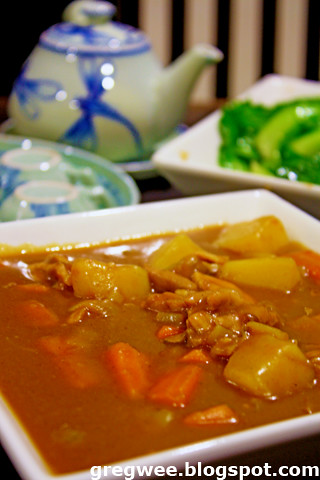
Japanese Style Chicken Curry

Greg is a curry lover, so much so that his Uncle John thought that he would marry an Indian girl one day. Obviously that didn't happen. Still, he maintains his unfledging passion for curry of all sorts & spices despite the fact that his stomach gets quite sensitive to it. So we've been cutting down on hot spicy food in general, but from time to time, we'd do a really hot one.
.
I totally forgot about the two packets of Japanese curry mix I had in my pantry (which I got from Melbourne). And they were about to expire in another few months. So that basically solved the problem of what's-for-dinner-tonite. And it was also an opportunity to quieten Greg down & give him his curry fix.

Japanese Curry tends to be slightly spicy sweet rather than hot spicy. It comes in hot, medium and light levels of spiciness. With Greg in mind, I went for medium spicy.
Japanese curry is also one of those dishes which are easy to cook cos it needs minimal culinary skills. Its unlike the local curries which need all the terrifying pounding, blending and stir frying of spices. You'd need an Indian wife to do that.

And the Japanese version is quick to do if its for chicken curry. Try this.

Feeds 4-5

3 pieces of chicken thigh deboned and rid of skin
2 no of med size potatos, large cube
2 no of med size carrots, large cube
2 cups of water
1 no of large onions, chopped

1) Clean and cut chicken into about 2 cm cubes. Seasoned with some salt and pepper for 1/2 hour.

2) With 2 tablespoon of oil, stir fry onion til brown and fragrant. Add chicken and continue to stir fry til slightly brown.

3) Add boiling water to cover the chicken and let it simmer from about 5 min. Add carrots and potatos and simmer for another 15 min.

4) Finally, add the chopped up packet of japanese curry mix. Stir until all mixture dissolve, bring to boil and mixture will thickens as you cook. Salt & pepper when necessary and add more water if too thick for your liking.

Serve with rice.

Wednesday, May 14, 2008

Temaki Sushi ~ Hand Rolled Sushi


We have been eating Japanese on and off these two weeks to sort of cool down after the many rich Italian dishes. And sushi has to be the most common staple. It makes simple, healthy meal. Basically, sushi is a combination of rice and seasonal seafood and/or a varieties of vegetables, combined in many ways ~ maki sushi, temaki sushi, futomaki sushi, nigiri-sushi, chirashi-sushi.

Like most Japanese food, sushi can be made easily at home but it must be noted that strictness in terms of ingredients and precision in the making process makes it something that takes professionals many years to master. So homemade sushi will always be homemade, for it would be quite impossible to achieve the proper professional standards especially in the area of knife work. But hey, it is still as tasty.


Among them all, the easiest has to temaki-sushi which is a hand-rolled cone made of nori-seaweed sheets, filled with sushi rice and a variety of other things. This one is easy to do & does not need any special equipment. And in a party environment, you can even get your guests to DIY their own.


Make8-10 pcs
300gm of short grain rice (preferrably Japanese)
350 to 400 gm of water
20ml of Japanese rice vineger (more if you like your rice more sourish)
a pinch of sugar say 1/2 teasp.

1) Wash rice and cook in rice cooker. Once cooked, place rice in a wooden or metal bowl and stir the rice to separate grain. Try slicing motion rather than stirring.

2) Drizzle vinegar and sugar and distribute evenly. Continue stir-slicing while having a fan blowing nearby all the time. Let the rice cool till your hand can hold on to it. If it's too hot, you will spoil the nori sheets (becomes wrinkly). Too cold, rice will be hard.

The best rice texture is slightly sticky yet the grain looks separate from each other.

4-5 nori sheets, slightly trimmed off the two ends and cut into two pieces
1/2 cup of japanese mayonaise
wasabi if you like
You can do basically any filling. Some suggested filling, cut to about 6 or 7 cm long are as following:
Crab stick, fish roe, cucumber, avocado and lettuce
Unagi - grilled eels, lettuce
Fishes like salmon, tuna with cucumber and lettuce
Terayaki chicken, avocados, carrots and lettuce
Deveined and deshelled and cooked jumbo shrimps with avocadoes and cucumber.


3) Take a small fistful of rice and place on the halved nori sheets. Fill up half of nori sheet. Spread and flatten evenly but don't press too tightly. The thickness should be about 3-4 grains of rice. Lift onto your hand.


4) Spread mayonaise and wasabi, followed by fillings, pointing to top left corner of sheets. Take the left bottom corner and fold pointing to the top right corner.


5) Using your finger, start rolling into a cone shape, tightening as you roll.


6) Serve in Temaki stand or place nicely on a nice flat plate.

Friday, April 25, 2008

Sukiyaki

Today the Faculty of Engineering had one of its marathon faculty meetings again, unfortunately not to announce salary increases or bonuses, but to dispense information to it's academic staff. So I was among the 70-80+ people trapped there for about 3 hours. The meeting started at a good 2pm, but it dragged on as usual, to a ridiculous 6pm.

While I was there in physical form, my mind had raced home. I was cracking my head on what to cook as Greg needed dinner at 7pm to be able to start working at 7.30pm.

So this is one of those times, when a one-pot cooking, instant meal comes to the rescue. Luckily, we have very thinly sliced beef from Ta Kiong and they did not take long to defrost.

Nabemono
is basically the Japanese version of one-pot cookery, which is really popular during winter. Of all the different versions, the two famous Nabemono we are accustomed have to be Sukiyaki and Shabu Shabu.


Sukiyaki is perhaps one of Japan's most classic one-pot dish. The dish mainly consists of paper thin beef and vegetables such as mushrooms, chinese cabbage and a raw beaten egg dip. And ingredients are normally cooked in a shallow iron skillet (preferrably Japanese ones) over an electric hot plate or a table top gas stove on the table. A small portion of the beef is lightly cooked and a small quantity of the rest of the ingredients and little stock are added and to be refilled as the meal progresses.


(Serves 2-4 persons)
200gm of paper thin beef slices
2tbsp of corn oil
1 no of piece of tofu, cut to cubes
8 no of pieces of fresh or dried shitake mushrooms, stem off and cut a cross on top of each
1 no of onion, sliced to rings
1 no of small baby chinese cabage
2 no of leeks, cut to finger lengths
some enoki mushrooms
2 no of eggs

Dashi stock:
200gm of water
1 tbsp of Dashi Granules
2 tbsp of sake
2 tbsp of Japanese soy sauce
1 tbsp of sugar

1) Clean and prepare all ingredients and lay nicely on clean plates, especially if you are getting the guests to cook by themselves.

2) Prepare stock by mixing dashi ingredients together.

3) Heat skillet with some oil. Lay beef in single layer to very lightly sear it, then scoop out. I cheated by doing the whole lot so I scooped out the meat first to prevent overcooking. Then proceed to step 4, 5 and 6. If you are doing the table cooking style, add small portion of beef followed by step 4.


4) Lay all ingredients nicely in the frying pan. Add stock. Bring to boil and simmer for a little till all ingredients are cooked.

5) Add beef back to skillet and also tofu. Bring to quick boil.

6) Bring the whole pot onto the table and eat with rice and raw egg beaten up. If you are cooking over fire on the table top gas stove, continue with the above till all ingredients run out.

Saturday, October 13, 2007

Gyu Nikku Udon: Learn Japanese 101

Greg and I love Japanese and Korean food! Two years ago, when we were in the exotic Land of the Rising Sun, we were like starving mad tourists. One of our favourite items is noodles ~ soba and udon. Udon and soba in soup is not exactly difficult to cook and can be easily done at home with equally yummy taste.

What confuses most people is the specifically Japanse flavour umami, which exists in almost anything Japanese. Typical chinese cooking is sweet, sour, salty, bitter, spicy. Umami is the ultimate 'tastiness' factor in Japanese cooking.

The Japanese use a stock called Dashi. And the best dashi is made with freshly shaved katsuobushi (smoked bonita fish flakes) and konbu (kelp) brewed in water and then strained to get the broth.

You can do two brews each time. Depending on the dish, you can use either the first or the second. Dashi stock makes the basic broth for noodle dishes. To make life simpler, we can use dashi granules (like our chicken or beef stock).

One of our favourite is Nikku Udon (meat udon) and we love the beef version (gyu). Would do this at home if I am lazy.

The stock:
1.8 - 2 liter of water
2 tbsp of dashi granules
2 tbsp of sugar
3 tbsp of light soya (Kikoman or Japanese brandshoyu)
1 tbsp of dark soya (Use Japanese brand)
1-2 tbsp of cooking sake
1- 2 stalk of leek, sliced thinly
150 gm of beef

1) Put all ingredients into a soup pot and boil. Add beef when boiling. Turn to simmer for 1 hour or so. Taste. If not tasty enough for you, add a little more dashi, sugar and light soya a little at a time.

Noodle:
Fresh packets of udon noodles or dried udon/soba noodles
Thin slices of beef (shabu shabu cut) 25 to 40 gm per person
More leek thinly sliced
Some anaori (small flakes of dried laver like nori to sprinkle)

2) Prepare a small pot of boiling water and put in noodles with boiling. If fresh udon cooking time is shorter like 3-5 min. Dried ones takes longer like 6-8 min. Make sure it is cooked through but not too soft.

3) Dish out and place in bowls. Turn up fire for soup, dip thin beef slices into boiling soup 30 sec per slice. Skip dipping if you like your beef raw. Place on top of noodles. Pour hot soup onto noodles. Sprinkle leek and anaori.

Soup will serve 4-5.

You can get most of the above ingredients from Choice Daily Supermarket in Stutong. I usually stock up whenever we go KL. Jusco and Isetan have a huge selection of Japanese ingredients at 15 to 30% cheaper than Kuching.

Nuffnang Ad