Showing posts with label Nee's Recipes : Asian Poultry. Show all posts

Thursday, April 8, 2010

Ka-Ca-Ma

I do not know where kacama originates from, nor does my mum nor my grandaunt. My guess is that since it's a herbal-based dish, it could probably have come from the Hakkas. The Hakkas are well known for their Lui Cha & their tradition of pepper farming (at least in Sarawak).Not quite sure whether the herbs is similar to those of a pepper tree. Anyone?

But kacama has always been a dish to be served after child birth. The kacama herbs are sometimes referred to as Yie Mu Chao (Benefit Mother Grass) and they are harvested and dried before bottling or more commonly nowadays in packets.  Along with Chicken Wine Soup and Pig's kidney and liver with lots of ginger, this is a very famous dish in Sarawak with the exception of Sibu to be taken to clean the womb and to rid of any blood clots after child birth. It has a warming effect, which is good for the new mother. Besides that, young girls who has tummyache during period can take this rich broth to improve their womb conditions as it is belived that tummyache is a sign of not so strong womb.
For us like many Sarawakians, we always like kacama for its fragrance & the spicy kick from the wine & the ginger. Kacama nowadays can be found in many fast food stalls just like any normal dish but it is usually very diluted. Cooking kacama is not difficult at all but a good kacama dish is not easy to cook, for it is the product of a perfect simbiosis between the right amount of wine, with the right amount of ginger, with the right amunt of herbs and chicken.
What you will need: 1 packet of kacama herbs.

This is actually the most difficult process of cooking this dish. 

The first concern is about buying the herbs, available at most markets in Kuching. This herb is plentiful but choosing a packet that is fresh, which means looking green, not brownish, is important. Check that there are minimum stalks in the packet. If there are too many stalks, then the packet generally will have less leaves and it is the leaves that we want.

Then comes the treating process.

1) Place herbs in a small wok/pan. With low to medium fire, slowly dry stir fry the herbs to brown. If you undercook the herbs, the dish will have a leafy taste. If you use too high a fire, you risk burning the herb and that brings a bitter taste to the dish. The process of stir frying must be slow and would usually take up to 1/2 hour of continued stirring and controlling of fire until the herbs turn dry (it will crackle up upon pressing with two finger) and greenish brown up and release a special fragrance. You should not see fresh green leaves at all.

2) Blend the greenish brown up herbs till fine and sift to rid of any stalks. The stalks if included into the dish is pretty annoying to bite and we want our kacama smooth. Store in airtight container for further usage.

1/2 no of chicken or 2 no of thigh meat, weighing about 1 kg
100-120gm of local ginger (less if you are not a ginger person)
4tbsp of treated kacama herbs
1 cup of chinese white wine
1/2 cup of chinese glutinous rice wine (optional or if you like a wine spicy dish use 1 1/2 cup of white wine in total)
3-4 tbsp of sesame oil


1) Clean and rid the ginger off the skin. Pound till fine with pestle and mortar. Squeeze the juice and set aside.
2) Heat the wok and slowly stir fry the ginger pulps with sesame oil till fragrant. Add chicken and continue stir frying till chicken pieces turn white.
3) Add herbs and coat all meat with herbs.
4) Add the two wine and ginger juice and transfer the dish to a chinese double boiler and double boil for 40 - 50 mins or till the meat is cooked thoroughly and fully absorbs the wine. 

Note:
We do not want meat so soft that it falls apart. That would mean that the soup has absorbed all the chicken flavour and the chicken is basically redundant and tasteless. The dish needs to be eaten meat and soup together. The cross balancing of meat with wine and herbs flavour, with chicken flavour in the soup is very important.

If cooking is done in a normal pot in braising style, add only half of the wine and cook for 30 - 40 mins. Add the other half portion of the wine 10 min before turning off the fire. Braising style tends to boil the dish up a little too much and evaporates the wine much more compared to double boiling. If you want to tone down the wine, then you can follow step 4  in the braising style and cook for roughly 30- 40 mins.
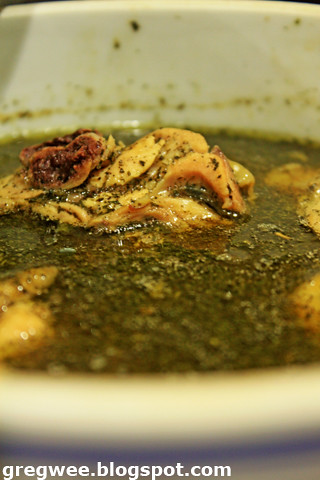

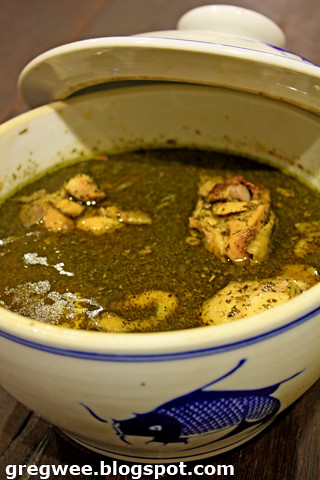
It is a dish you either love or hate. But most Sarawakians like our affection for our Laksa tend to have own respective favourite taste to this dish. Some like it diluted with less wine spike, we like is with a lot of wine spike and a slight sweet notation (hence the glutinous wine step) and others love it so spicy they just really spicy white wine. Adjust the recipe to your liking. Serve with a bowl of nice fragrant jasmine rice. Yum!

Monday, March 15, 2010

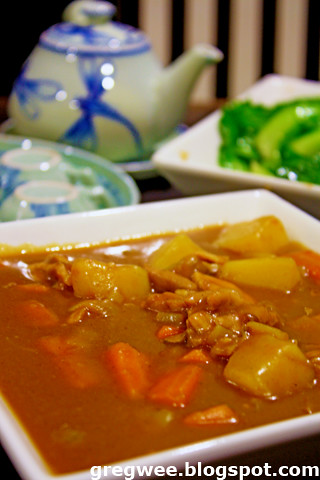
Japanese Style Chicken Curry

Greg is a curry lover, so much so that his Uncle John thought that he would marry an Indian girl one day. Obviously that didn't happen. Still, he maintains his unfledging passion for curry of all sorts & spices despite the fact that his stomach gets quite sensitive to it. So we've been cutting down on hot spicy food in general, but from time to time, we'd do a really hot one.
.
I totally forgot about the two packets of Japanese curry mix I had in my pantry (which I got from Melbourne). And they were about to expire in another few months. So that basically solved the problem of what's-for-dinner-tonite. And it was also an opportunity to quieten Greg down & give him his curry fix.

Japanese Curry tends to be slightly spicy sweet rather than hot spicy. It comes in hot, medium and light levels of spiciness. With Greg in mind, I went for medium spicy.
Japanese curry is also one of those dishes which are easy to cook cos it needs minimal culinary skills. Its unlike the local curries which need all the terrifying pounding, blending and stir frying of spices. You'd need an Indian wife to do that.

And the Japanese version is quick to do if its for chicken curry. Try this.

Feeds 4-5

3 pieces of chicken thigh deboned and rid of skin
2 no of med size potatos, large cube
2 no of med size carrots, large cube
2 cups of water
1 no of large onions, chopped

1) Clean and cut chicken into about 2 cm cubes. Seasoned with some salt and pepper for 1/2 hour.

2) With 2 tablespoon of oil, stir fry onion til brown and fragrant. Add chicken and continue to stir fry til slightly brown.

3) Add boiling water to cover the chicken and let it simmer from about 5 min. Add carrots and potatos and simmer for another 15 min.

4) Finally, add the chopped up packet of japanese curry mix. Stir until all mixture dissolve, bring to boil and mixture will thickens as you cook. Salt & pepper when necessary and add more water if too thick for your liking.

Serve with rice.

Sunday, October 18, 2009

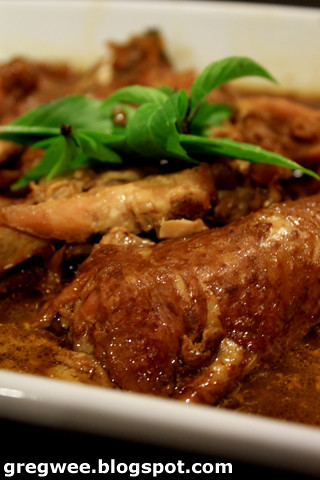
Basil Chicken with Calamansi Lime

I am such a lousy gardener that the only thing that is kinda surviving are my thai basil and pandan plants. But Greg's Aunty Gim Ai is such a wonderful gardener that everything thrives. Just yesterday she gave me a whole bunch of calamansi lime and kedondong straight from her garden.

So, here's another simple recipe that cannot fail. With the tanginess of the basil and refreshing taste of calamansi lime (in Hokkien S'ng Kam), this dish will definitely conjure your senses.

Feed about 4:

1/2 no of big kampung chicken* or 1 medium free range chicken

Seasoned with:
3 tbsp of light soya,
1 tbsp of dark thick soya
1 tbsp of sesame oil
1 teasp of salt and pepper
1 tbsp of chinese cooking wine like hua tiaw
1 med no of brown onion/5-6 no of red shallots, chopped finely
5-6 slices of ginger
5 no of calamansi lime
2-3 tbsp of sugar


* i used this because i had a few huge gorgeous kampung chicken all the way from Sibu. I think you can only get solid looking fellows around that region nowadays. Chickens here no matter what the sellers claim looks sickly and underexcerised. Almost like child abuse!

1) Season chicken for an hour before cooking.

2) Heat up wok/pot with some oil and stir fry onions with ginger till fragrant and light brown. Add basil leaves.

3) This is followed by the chicken without the seasonings. Stir fry till chicken is all coated with basil, ginger and onions.

4) Add 1/3 cup of water to the seasoning and add into the chicken. Bring to a boil and turn to small fire to cook for 35- 45 min depending on your chicken till soft. I pressure cook for 30 min last night but that was overcooking (meat were all falling off the bones). Try pressure cook for 20 min.

5) Finally add sugar and lime, stir and taste for sweetness and sourness.

Get ready your rice or porridge! I still had some left from last night. So tonight will just be steamed prawns and vegies with this.

Wednesday, August 13, 2008

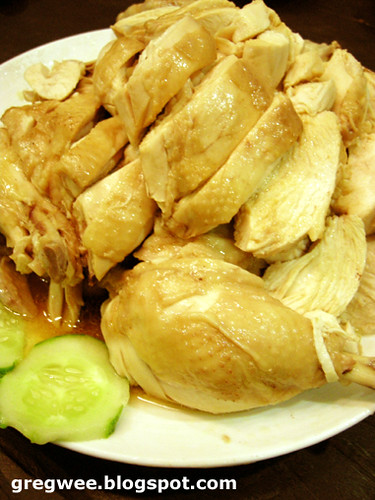
Hainan Chicken Rice


A while ago, our good friend and an accomplished violinist, who played at our wedding, Sie Ai, left for the States for her PhD. Before she left, I was supposed to write her a list of recipes for local food (as payment for her services - just kidding). And one of it is this dish which I have been procastinating.

And guess what? Two nights ago, she actually popped up at our place. It was a surprise visit and we were totally shocked. Greg's teeth nearly dropped out. She was back to collect some data and decided to surprise us. Thank you Sie Ai for thinking of us. But it kind of reminded me that I had not blogged any of the dishes which she requested before. How terrible of me!

So since I had cooked this a week ago, I thought I must write it down before I get lazy again.

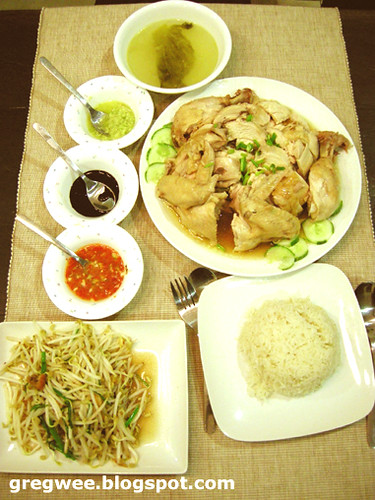
Hainan Chicken Rice is basically a set meal of rice with chicken, served with chicken soup and chilli and ginger dip. From rice to all the accompaniments, the chicken soup stock from cooking the chicken is used. And it is really not difficult to make. My problem is always cutting the chicken up nicely and evenly and of course picking the right chicken to use is important too.

Serve 4-6

The Chicken
1.8 to 2 kg of chicken*
1 tbsp of salt
1 tbsp of minced garlic
1/2 tbsp of minced ginger
3-4 stalks of spring onion
1 no of thumb size ginger smashed
Water to cover chicken

1) Mix salt, minced garlic & ginger together and rub it all over the chicken. Stuff the spring onion and smashed ginger into the cavity of the chicken.

2) Boil a large pot of water and place the chicken in tummy side down, water covering the chicken. Boil over med-hi fire for 10-15 min depending on the size of the chicken. Turn the chicken over and continue boiling for another 9-12 min. Check for doneness by piercing the thigh area and check for the juice that runs out. If it is still pink, continue boiling for another 5 min or so. Turn off fire and let the chicken soak in the soup with lid of pot closed for 30 min. Soaking will help the chicken texture to be smoother.

* Choosing the right chicken is essential. I personally like corn fed or free range ones with nice layer of skin for chicken rice purpose And I would normally ask whether the chicken feather is hand plucked or machine plucked. Machine plucked one usually thins out the skin, causing it to tear during boil cooking. But it is a matter of preference. Some people actually like whitish looking, naked fatless chicken with practically no skin on.

3) Carefully dish out the chicken and place on a plate to dry. You can hang it if you want to. Spoon some chicken oil sauce over the chicken, gentlly rub the sauce all over chicken and let it cool before cutting.

Chicken Oil Sauce:
1 rice bowl of top layer of chicken soup and oil, especially the oil bit
1 tbsp of sesame oil
3 tbsp of light soya
1/2 teasp of sugar

1) Mix all ingredients together.

The Rice:
450 - 500 gm of jasmine rice
50 gm of glutinous rice
2-3 stalks of pandan leave
2-3 slices of ginger
1 tbsp of minced garlic
1 teasp of salt and pepper
500-600 gm of chicken soup and oil, more if you like your rice wetter

1) Wash the rice and strain off water.

2) Heat wok with oil. Stir fry garlic and ginger till fragrant. Add rice and continue stir frying. Add salt and pepper.

3) Place in normal rice cooker. Add pandan leaves and chicken soup and cook like usual.


The Soup:
1.5 litres of Chicken soup
1 no of Szechuan vegie, size of baby fist, washed and sliced thinly
1 stalk of salty vegies, washed

1)Boil chicken soup and add the vegies. Simmer for a little while before serving


The Sauces:

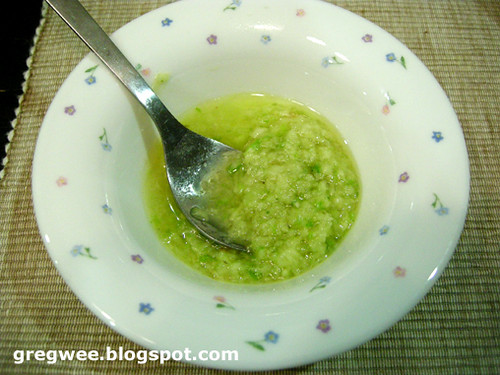
a) Chilli Dip

5 no large chillis
10 no of limau
2 tbsp of sugar
3/4 tbsp of minced garlic
some salt approx 3/4 to 1 teasp
5-6 tbsp of chicken oil from the soup

1) Chop or blend chillis and 3-4 limau skin into fine bits.

2) Squeeze limau juice. Mix all the ingredients together. Set aside.


b) Ginger and Onion dip

50 gm of ginger
50 gm of spring onion bottom white part
1 tbsp of sesame oil
3-4 tbsp of chicken oil from the soup
1/2 teasp of salt

Edited: I realised that I did put instruction for my dip. Shred the ginger to fine bits. Chop the spring onion bottom to fine bits. Add oil and chicken oil and seasoning.


c) Dark soya Sauce

Serving:
Dish rice and press tightly into a rice bowl and flip it onto a serving plate. Cut chicken and place them on individual plates or a large centre plate. Spoon more chicken oil sauce over meat right before serving. Garnish with cucumber and top with coriander leaves. Serve with soup and dips and soya sauce.

According to Greg's Uncle Francis, chicken rice in Hainan does not taste like ours and is certainly not so flavourful. So let's enjoy our version. It is not sooooo difficult to make. So if you are worried about commercial chicken rice outside, DIY.

Friday, April 4, 2008

U'ng Chow Chicken

This is a very well-known Sarawakian Foochow dish which is usually home cooked. For some reason, you don't usually find this in restaurants. U'ng Chow chicken uses the lees (U'ng Chow) which are the residues from the Foochow Red Wine (U'ng Chew) making process.

I cook this dish very much like how some people do with soya chicken. The chicken blends well with the U'ng Chow which gives off a wonderful aroma. The sweet taste of the U'ng Chow can be very addictive. But maybe for some, it is an acquired taste.

And very coincidentally today, Suzanne actually talked about missing Uang Chow and this dish. So here is the recipe:

1/2 no of med-large or 1 small no of free range chicken
1 heaped tbsp of U'ng chow
1 teasp of salt
1 tbsp of sesame oil + 1 tbsp of vegie oil
3-4 slices of ginger, at the length of a thumb
1 tbsp of minced garlic
3 tbsp of light soya
3 tbsp of sugar
1/2 cup of Foochow Red Wine

1) Clean and chop chicken to smaller pieces. Season with U'ng Chow and salt for at least 3 hours.

2) Heat your wok with oil. Stir fry ginger and garlic til fragrant.

3) Add chicken and stir fry till chicken are coated with oil and garlic and ginger. When chicken pieces are slightly shrinking, add light soya and 1/2 of the Red wine and 1/4 cup of water.
(Tips: Add the 1/4 cup of water to the bowl where you seasoned the chicken and wash out any leftover U'ng Chow in there.)
Close lid and let it simmer at med-small fire for til soft.

4) Add sugar and stir. Turn up fire and let juice boil till half the original amount and sticky. Boil to reduced slightly only if you like more sauce to go with the rice. Right before turning off the fire, add rest of red wine.

Serve with rice.

Thursday, February 28, 2008

Red Hot Curry Chicken


Cooking Curry Chicken can be easy with ready made curry powder and are usually edible. However, a good dish of curry chicken is signified by:

1) Well blended taste ~ not too hot and spicy yet with enough 'lemak' (direct translation: thick and oily)
2) After cooking, chilli oil will float upwards ('naik minyak')
3) Coconut milk is well blended, i.e. not separated from the rest of sauce
4) The dish will last, unless everyone sticks their spoons into the pot or the dish is left sitting for more than a day in hot and humid weather


I usually cook mine using the 'tumis' method, which makes it more lasting and the overall taste is very lemak.

1 no of chicken about 1.5 kg, chopped into pieces
3-4 medium potatos, quartered or slightly smaller
1 no of coconut + 1/2 glass of water squeezed about 500gm of coconut milk
3 tbsp of red onion
2 tbsp of garlic
1 small packet of babas curry powder or 4 tbsp of good quality curry powder
2 pieces each of cinammon sticks, cardormon seeds, star anise and cloves
1/2 cup of oil
1 stalk of curry leaves (optional)
1 serving of spice mixture
salt and pepper to taste


Spice mixture:

I usually mix my own rather than buying ready packed ones from Indian stalls so that I would have no prob cooking this overseas in case I need to:

2 tbsp of ketumbar paste
3-4 tbsp of chilli paste
11/2 tbsp of kunyit paste
1 tbsp of jintan manis paste
1/2 tbsp of jintan puteh paste
1 tbsp of buah keras paste
1-2 tbsp of fried coconut/kerisik (optional)
1 stalk of lemongrass, chopped and blended
1/2 tbsp of kakas (optional)


1) Season the chicken with curry powder and light soya. Set aside for an hour or so.

2) In a heated wok, with 1/2 portion of oil and medium heat, stir fry the chilli paste till chilli oil starts appearing on the side of the chilli paste.

3) Add garlic and red onion and continue stir frying till fragrant. Add rest of the oil and then rest of the paste mixture, the cinammon stick, star anise, cardarmon and cloves. Stir fry till well done and fragrant. Drizzle some coconut milk (about 6-8 tbsp from the top of the coconut mixture) and stir fry till you see sizzling oil start appearing on the side of the mixture. This is the tumis method. Will ensure the 'naik minyak' bit and lemak bit.

4) Add chicken and stir fry with (3). Cover and simmer the chicken till it looks slightly shrunk. Add rest of coconut and let it boil. Then leave simmering with chicken, curry leaves and potatos till cooked. During simmering use low fire, pot lid half covered and stir occasionally so that the mixture is not burnt at the bottom. This will ensure the lasting bit and coconut milk will not separate.

5) Add seasoning as required. Taste with clean utensils.

Friday, November 23, 2007

Salt Baked Chicken

Yim Gud Gai (Cantonese translated direct Salt Baked Chicken) is a traditional Hakka signature dish. Chicken meat baked with salt (yes, salt) interestingly gives very tender and moist results in the texture.


In terms of taste, it is not supposed to be salty as the name would suggest. The taste is usually from the different flavours that can be added onto it. This dish can be cooked with chinese herbs like dang gui, red dates & thornberry. To have a local twist, we can bake the chicken in salt and banana leaves. And some would do it plain with just rice wine, sesame oil, salt and pepper.


It is actually quite easy to confuse it with the traditional Beggar's Chicken, which is cooked wrap in a salty dough and would require a hammer to crack it open after cooking. Yim Gud Gai is much simpler in the number of steps. Last week Dad bought this dish all the way from Ipoh from one of their famous store called Aun Kheng Lin (Riceballz's blog talks quite extensively on this shop). So picking up some ideas from this shop, I did mine as follows:


1 no of small spring chicken or small free range chicken, approx 1.2 kg
3 pieces of dang gui, washed
4-5 pieces of red dates, washed
1 teasp of thornberry, washed
1/2 to 3/4 tbsp of salt and pepper (edited)


3 pieces of large baking paper (grey or white), big enough to wrap the whole of chicken in 6 folds
2-3 kg of coarse salt


1) Clean chicken well and delete the head and neck portion, stuff chinese herbs in the cavity of chicken. Pat dry and rub the whole chicken with salt and pepper. Set aside to marinade for an hour or so. Wrap it up in the baking sheets, sealing up the chicken really well. (I did mine in two layers only and the paper was a little burnt, which then transmit the burnt flavour onto the chicken, we both liked that. But if you don't want it that way, i would suggest 3 pieces and a final layer of aluminium foil)


2) Put more than 1/3 of the 3kg salt in a old big wok with a steeper slant. You would not want to cook this in an expensive wok or pot as heating will cause the wok to brown slightly. Steeper slant will help reduce the amount of salt used.


3) Put the wrapped chicken on top of the salt, with the tummy side up, and cover the rest of the chicken with more salt. Cover and bake over medium fire for 45 mins to 1 hour depending on the size of chicken. I did mine for 35 mins and it was slightly under cooked around the thigh area. So please do try longer.


4) Dig out the chicken from the salt. Be careful that you dont accidently tear the paper off and let the chicken touch the salt. You will have really salty chicken if that happens. Uncover and test by piercing the thighs and if juice flows out then chicken is clear it is done. Cool slightly before chopping and serving. Another wonderful point about this recipe is you can serve it as a cold dish.

TIP:
Another really easy way of baking this chicken is with banana leaves. Place layers of banana leaves on top of salt. Rub chicken with a little salt and pepper. Cut chicken across back and flatten against leaves. Line with some more layers of banana leaves, then cover completely with salt. Bake for 45 mins to 1 hour. You will have juicy chicken with a tinge of banana leave flavour.


Salt, leaves, chicken


Leaves, salt and szechuan peppercorn

Thursday, November 8, 2007

Mum's Lemon Chicken

In every western country including Australia, there are Chinese restaurants. And in every one of these western-Chinese restaurants, they serve two mistakes. One of them is Sweet Sour Pork (Ku Lo Yuk) and the other is Lemon Chicken (Ling Mong Zi).

I do not why or how this came to be but it seems that these two dishes are always there upfront on the menu. They are like the national anthem of the western-Chinese restaurants.

When I was still a young & attractive student studying in Melbourne Uni, I was always served with this crappy delight in the infamous Oriental Chef. Usually the chicken is tasteless, and the only thing that has a taste is the recycled oil. They should call it Sweet Sucky Sour Pork & Lemon Sucky Chicken.

But thinking back now, my mom could have super-spoiled me with her own version of lemon chicken. Her recipe is a little bit different. It's not one of those pour-pathetic-lemon-with-cornflour-sauce-over-deep-fried-chicky type. Here's how it goes:


2 pieces of chicken thigh meat deboned

Marinade Sauce:
1 teasp of salt
1/2 teasp of pepper
1 tbsp of sugar
2 tbsp of maggi seasoning sauce
1 tbsp of light soy

Batter for Frying:
1 egg, beat lightly
2 tbsp rice flour + 1/2 tbsp plain flour + 1/2 teasp of baking powder with some water as frying batter. More water if you like it thinner.

Lemon Sauce:
1/3 cup of water
1/2 no of good quality fresh lemon juice
2 tbsp of maggi seasoning sauce
1 tbsp of light soy
2 tbsp of sugar
1 tbsp of cornstarch
Leftover marinade sauce

1) Clean and season the chicken chop/thigh with marinade sauce. Set aside for at least 3 hours.

2) Strain and coat with egg, then the frying batter.

3) Heat wok and add chicken once the oil is hot enough. Deep fry with medium fire to cook the chicken. Turn to high for the last one min or so to golden brown the chicken chops. Cool slightly and chop to slices.

4) With a small pan, boil sauce. Finally add strained Lemon juice. Tip: Add lemon at the end as lemon loses its flavour if overboiled. Add some more sugar if you find it too sour.

5) Serve separately or pour over chicken slices.

Saturday, September 22, 2007

Easy Grilled Chicken Wings

When I first arrived in Melbourne, first thing I noticed is how cheap wings are. Then Uncle Tony whom I was staying with declared that it is the easiet food to cook in the world. After 5 times a week of wings, I realised he meant grilled wings. And that is practically the first dish i learn besides boiling rice and cooking chicken soup. Ya i was that bad then.

Wings will featured in all overseas students' meals, parties, church lunch, bbqs, pot lucks. If you dont organise your pot luck you will have 10 different people bringing wings. Well, that is because wings are nice even though parents will declare they put injections of hormone there. Well after many years of wings, i dont get any bigger khmm khmm..at certain anatomy, neither did my brothers. So it cannot that bad but please dont have it everyday. Like all food, moderation is the best.

And wings are suprisingly easy to cook because it has the meaty part and the tender part and therefore whichever you cook it cannot taste bad ~ grilled, stewed, fried ~ deep or pan, steamed etc. We had this fren's fren's fren's boyfren (i dont even remember exact guy so cannot put his name here) who work in a restaurant part-time and he gave us this really nice recipe to do grilled wings. Well it is nice and easy that i never grill it any other way since and i have raving guests to prove. Especially good when you have children at your party. This will be the first dish they point to.

6-8 fresh chicken wings
5 tbsp plum sauce (Lee Kum Kee is good)
2-3 tbsp of light soy
1 tbsp of sugar
3/4 teaspoon of salt

1) Marinade overnight in fridge or for those working ladies, you can do it in the morning and keep it in fridge.

2) Heat up your oven (broiling mode ~ upper fire with the sign of saw teeth) to about 180 deg cel. Line aluminium foil in roasting pan and place your wings on. Broil for 15 - 20 min til golden brown and skin looks puffy.

3) Turn sides and brush with marinade sauce and cont broiling for another 15-20 min.

4) Turn back to original side and pour all your marinade sauce on. Turn up heat to about 200 deg cel. This is to brown it nice. Watch your wings consistently for 10 min or so. The sauce should kinda dry up and looks sticky. Be careful of burning them.
Serve 2-3

Note:
Greg loves slightly burn part but i usually slap it off him if he dares to put into his mouth. Tip will usually look burned but that will kinda release a special flavour to other parts. Just dont eat that bit. Otherwise, wrap the tip with aluminium foil.

Broiling is the oven version of grilling. I always think grilling is best describe with fire below and it is open. If you dont have a proper oven, use the turbo hats one can do. That was what Uncle Tony did anyway for all the years. Temperature should be about the same.

Recipes will apply for bbqs.

Nuffnang Ad